



Solar Drying Technology: A farmers Guide.
Learn about solar drying technology with our complete guide. Learn to build affordable solar dryers, dry crops faster, and increase farm income in Uganda.

Introduction
Ugandan farmers lose 20-40% of their harvest to mold, rot, and aflatoxin contamination due to improper drying. Traditional sun drying takes too long, exposes crops to contamination, and depends entirely on weather. Consequently, farmers watch profits disappear before their eyes.
Table Of Content
- Introduction
- What is Solar Drying Technology?
- Key Benefits of Solar Drying
- Types of Solar Dryers
- Building a Simple Solar Dryer
- Materials Needed (2m x 1m cabinet dryer)
- Construction Steps
- Best Crops for Solar Drying
- Operating Best Practices
- Maintenance and Troubleshooting
- Economics and ROI
- Support and Group Investment
- Success Stories
- Getting Started
- Conclusion
However, solar drying technology offers a game-changing solution. Indeed, solar dryers reduce drying time by 50-70% while protecting crops from rain, dust, insects, and animals. Moreover, these affordable structures can be built using locally available materials.
Therefore, investing in solar drying technology is one of the smartest decisions a farmer can make. Furthermore, properly dried crops command premium prices and last longer in storage. This guide covers everything you need to know about solar drying technology.
What is Solar Drying Technology?
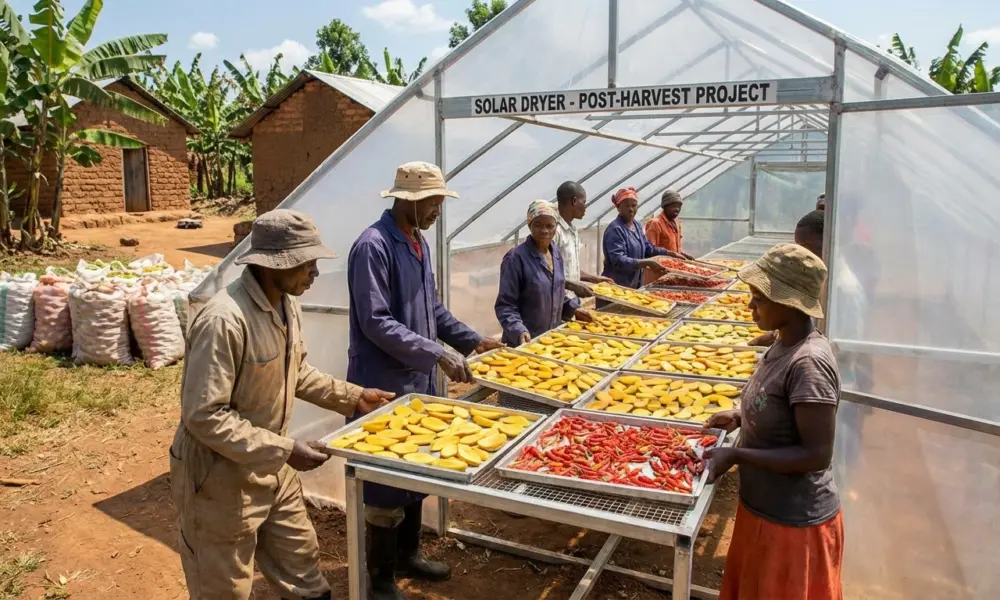
Solar drying technology uses the sun’s heat to remove moisture from crops in a controlled environment. Unlike open-air sun drying, solar dryers concentrate heat, improve air circulation, and protect produce from contamination. They maintain optimal temperatures (40-60°C) that preserve crop quality while preventing microbial growth. Learn more about post-harvest loss reduction strategies
Key Benefits of Solar Drying
Solar dryers reduce drying time by 50-70% compared to sun drying. Moreover, controlled drying preserves color, flavor, and nutrients, leading to premium market prices. Additionally, protection from weather, dust, and pests ensures cleaner, safer products with reduced aflatoxin contamination.
Furthermore, solar dryers require no electricity or fuel and can be built with local materials. Consequently, the investment pays for itself within one or two seasons through reduced losses and better prices. Properly dried crops (below 13% moisture) last months longer in storage.
Types of Solar Dryers
Cabinet Dryers: Small box-like structures perfect for household use. Best for small quantities of vegetables and fruits.
Tunnel Dryers: Long greenhouse-style structures for large-scale operations. Ideal for farmer cooperatives processing several tons simultaneously.
Direct vs. Indirect: Direct dryers expose crops to sunlight (best for grains), while indirect dryers heat air separately (better for fruits/vegetables to preserve color).
Building a Simple Solar Dryer
Materials Needed (2m x 1m cabinet dryer)
Timber/bamboo frame, UV-resistant polythene or glass, black paint, wire mesh, nails, hinges. Total cost: 150,000-300,000 UGX.
Construction Steps
Build an elevated wooden frame sloping 10-15 degrees toward the sun. Create removable wire mesh trays spaced 10-15cm apart. Paint the back wall black to absorb heat. Install transparent covers on top and front. Add bottom inlet vents and top outlet vents for air circulation.
DIY dryers cost 50-70% less than commercial ones. However, professional models offer better efficiency and warranties. Therefore, consider your budget and skills before deciding.
Best Crops for Solar Drying
Grains: Maize, rice, beans (2-4 days drying time) Fruits: Mangoes, pineapples, bananas (1-3 days when sliced) Vegetables: Tomatoes, onions, carrots, peppers (1-2 days) Cash Crops: Coffee, cocoa, herbs, spices (2-5 days)
Explore climate-smart farming strategies for Uganda
Operating Best Practices
Preparation: Sort and clean crops, remove damaged items, and pre-treat if needed (blanch vegetables, dip fruits in lemon juice).
Loading: Spread crops in single layers with space between items. Don’t overcrowd trays. Load similar moisture items together.
Monitoring: Check temperature daily (40-60°C), rotate trays for uniform drying, and test moisture regularly using visual, touch, or moisture meter methods. Grains should reach 12-14% moisture for safe storage. Read about organic pest control for stored crops
Maintenance and Troubleshooting
Daily: Clean covers, check vents, remove debris Weekly: Wash trays, inspect seals, check for wear Seasonal: Replace damaged polythene, repaint surfaces, treat wood for termites
Common Problems: Slow drying (reduce load, improve ventilation), uneven drying (rotate trays, space evenly), overheating (increase vents, add shade), mold (extend drying time, improve airflow), color fading (use indirect design, pre-treat crops).
Economics and ROI
Investment Costs: Small cabinet (150,000-300,000 UGX), Medium tunnel (800,000-1.5M UGX), Large commercial (3-10M UGX).
Example ROI: A 1M UGX dryer processing 10 tons annually saves 30% losses (3 tons worth 3.6M UGX). Payback period: 4 months.
Value Addition: Fresh mangoes (1,500/kg) → Dried chips (8,000/kg). Fresh tomatoes (1,000/kg) → Dried (6,000/kg). Therefore, solar drying enables profitable value addition.
Support and Group Investment
Ministry of Agriculture (MAAIF) provides training and material subsidies. NAADS offers extension services. Uganda Industrial Research Institute (UIRI) provides dryer designs and technical support.
Farmer Cooperatives: Sharing a dryer among 10-20 farmers reduces costs by 80-90%. Groups can afford larger commercial dryers and share maintenance.
Success Stories
Luwero mango farmers: 15 farmers invested 2.5M UGX in a tunnel dryer, now produce dried mango chips selling at 8,000 UGX per pack. Income increased 400%.
Kasese coffee farmers: Cabinet dryers reduced drying time from 14 to 4 days, improving quality and earning 35% higher prices.
Kampala vegetable growers: Women’s group processes excess vegetables year-round, supplying restaurants and creating employment for 30 women.
Getting Started
Step 1: Assess your drying volume, crop types, and budget Step 2: Attend training or visit farmers using solar dryers Step 3: Start with a small cabinet dryer to gain experience Step 4: Track results and optimize operations Step 5: Scale up or organize a cooperative dryer
Contact us for training programs
Conclusion
Solar drying technology offers Ugandan farmers a practical, affordable solution to reduce post-harvest losses by 50-70%. Indeed, it improves product quality, enables value addition, and increases income without requiring electricity or expensive equipment.
Moreover, with costs starting from 150,000 UGX and payback periods as short as 4 months, solar dryers represent one of the best agricultural investments. Furthermore, government support and cooperative models make this technology accessible to farmers at all scales.
Therefore, start your solar drying journey today. The sun is shining—capture its power to transform your harvest into lasting prosperity.

No Comment! Be the first one.