

EU-Funded Project Opens GLOBALG.A.P. Certification Support for Uganda’s FFV Sector in Uganda.
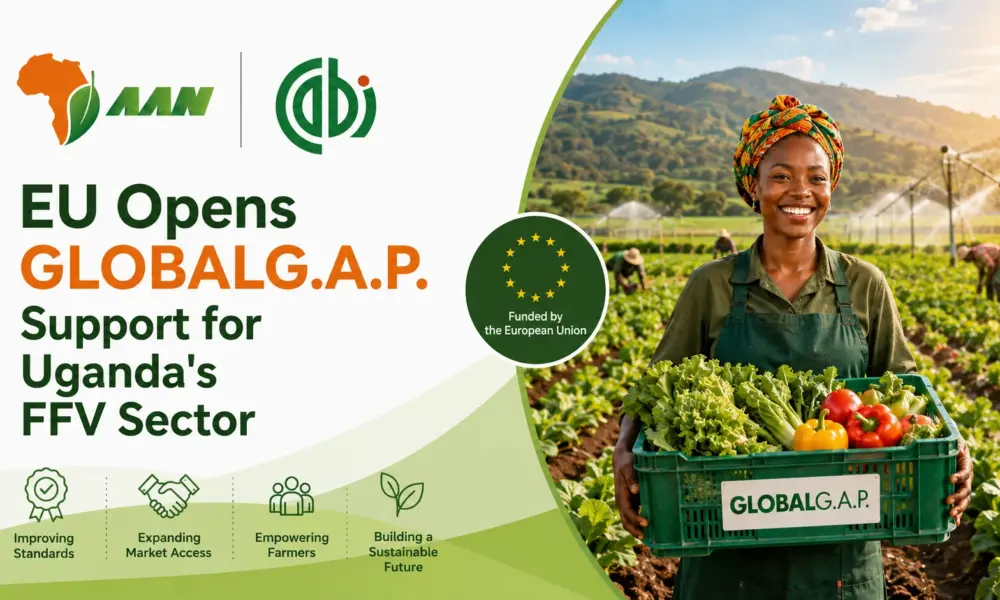
Uganda's EU-funded SPS Project is offering FFV producers up to 50% support for GLOBALG.A.P. certification costs.

Uganda’s fresh fruits and vegetables sector is sitting on one of the most significant untapped export opportunities in East Africa. The European Union’s Everything but Arms trade agreement already allows Uganda to export goods to Europe quota-free and tariff-free. The infrastructure for access is therefore already in place. What has been holding Ugandan horticulture exporters back, however, is not market access on paper. It is the food safety and plant health certification gap that causes produce to be intercepted and rejected at European entry points before it ever reaches a shelf.
Table Of Content
That gap is now being directly addressed. CABI, the Ministry of Agriculture, Animal Industry and Fisheries (MAAIF), HortiFresh, and COLEAD have teamed up as part of a new project funded by the European Union Commission targeting horticultural produce including fruit and vegetables, with a focus on capsicum, garden eggs, Hass avocado, mango, and okra. Through this partnership, the EU-funded SPS Uganda Project is now inviting eligible MSMEs across Uganda’s fresh fruits and vegetables value chain to apply for support towards GLOBALG.A.P. certification before the deadline of 30 July 2026.
Successful applicants can receive up to 50% support for certification costs, alongside technical assistance, training, and compliance support that can open doors to high-value export markets including the European Union. Furthermore, female-led enterprises and youth-owned MSMEs are especially encouraged to apply, reflecting the programme’s commitment to inclusive agricultural development across Uganda’s horticulture sector.
The Problem This Programme Is Solving
Uganda’s horticulture sector has enormous export potential, but it has consistently lost revenue to a challenge that is entirely solvable with the right support and standards infrastructure in place. Despite notable exports, Uganda has a limited share of the EU market. This is due to produce being intercepted and rejected because it does not meet required SPS standards. Exports are being intercepted and rejected because of harmful organisms, excessive maximum residue limits that are not in line with EU standards, and documentation errors.
The financial cost of this compliance gap is staggering. By reducing export rejections and improving compliance with international standards, the SPS Uganda Project is expected to unlock as much as US$150 million in additional revenue for the country’s horticultural sector. Consequently, what the SPS Uganda Project is offering through this GLOBALG.A.P. certification support call is not simply a subsidised audit. It is a structured pathway to the compliance infrastructure that Ugandan horticulture businesses need to capture their rightful share of one of the world’s most lucrative food markets.
What Is GLOBALG.A.P. and Why Does It Matter?
GLOBALG.A.P. is an international quality standard for agricultural, horticultural, and aquaculture products. Food safety, labour, environmental, and animal welfare requirements are incorporated in GLOBALG.A.P. guidelines alongside integrated farming, pesticides, residue monitoring, and hygiene standards. Large retail chains often expect their agricultural suppliers to provide GLOBALG.A.P. certification.
For Ugandan fresh fruits and vegetables producers and exporters, GLOBALG.A.P. certification is consequently not a bureaucratic formality. It is the commercial passport that unlocks access to European supermarkets, premium buyers, and high-value export markets that are simply unavailable to uncertified producers. Furthermore, in a European market that is tightening food safety and sustainability requirements year on year, GLOBALG.A.P. certification is increasingly the baseline expectation rather than a differentiating premium.
Achieving and maintaining this certification, however, requires structured technical knowledge, financial investment, and compliance management capacity that many Ugandan MSMEs in the FFV sector currently lack. This is precisely the gap that the SPS Uganda Project’s certification support programme is designed to close.
What the Support Package Covers
The SPS Uganda Project is offering a comprehensive support package to successful applicants that goes well beyond financial subsidy alone.
Successful applicants will receive up to 50% of GLOBALG.A.P. certification costs covered, making the financial barrier to achieving internationally recognised food safety certification significantly more manageable for MSMEs that might otherwise find the full cost prohibitive. This co-financing model furthermore signals to the market that the applicant is serious about compliance, as applicants must demonstrate commitment to co-finance the remaining 50% of GLOBALG.A.P. certification costs.
Beyond the financial support, participants receive technical assistance and training on Good Agricultural Practices (GAPs), Integrated Pest Management (IPM), and the specific requirements of GLOBALG.A.P. compliance. This training component is critically important because certification without the underlying knowledge and practice to maintain standards is neither sustainable nor commercially valuable. Additionally, participants receive structured support to strengthen compliance with EU food safety and plant health regulations and to build the market access relationships that make certification commercially rewarding.
Who Should Apply?
The call for Expressions of Interest is open to MSMEs across Uganda’s fresh fruits and vegetables value chain that are ready to invest in compliance and market access development. Specifically eligible applicants include:
FFV producers who are growing the crops that fall within the project’s target commodities including capsicum, garden eggs, Hass avocado, mango, and okra, and who are committed to meeting the Good Agricultural Practice standards required for GLOBALG.A.P. certification. Producer organisations and farmer groups that aggregate production from multiple smallholder members and are seeking to build compliance capacity at the organisational level. Exporters who handle and market fresh fruits and vegetables and who need GLOBALG.A.P. certification to access or retain relationships with EU and premium regional buyers. Nucleus farms with outgrower schemes that are supporting surrounding smallholder farmers to produce to commercial and export quality standards.
Furthermore, female-led enterprises and youth-owned MSMEs are highly encouraged to apply, regardless of gender, age, location, disability status, or socio-economic background, reflecting the programme’s commitment to inclusive and equitable access to export market opportunities across Uganda’s horticulture sector.
The Partnership Behind the Programme
The SPS Uganda Project brings together one of the most credible and experienced agricultural development partnerships currently operating in Uganda.
CABI, a nonprofit intergovernmental scientific and technical organisation working in agriculture, the environment, biosecurity and sustainable development that combines applied research, field projects and scientific publishing, is leading the project. Uganda has been a member of CABI since 1995, and the relationship was further formalised in May 2026 when CABI signed a Host Country Agreement with the Government of Uganda, marking a significant deepening of its long-term commitment to agricultural development and food safety across the country.
MAAIF brings the government’s plant health and food safety regulatory authority to the partnership, ensuring that the project’s interventions are aligned with Uganda’s national agricultural export strategy and SPS compliance framework. HortiFresh Association Uganda represents the private sector horticulture industry, bringing direct industry knowledge and stakeholder relationships to the programme’s implementation. COLEAD brings specialised expertise in standards, trade, and agricultural value chain development that complements the technical and institutional strengths of the other partners.
Together, this partnership consequently creates a programme that is simultaneously technically credible, institutionally grounded, and commercially oriented, making it one of the most well-structured horticulture certification support initiatives Uganda has seen.
Why This Matters for Uganda’s Agricultural Export Future
Uganda’s agricultural export growth story is one of the most compelling on the African continent. As AAN has documented across its coverage of Uganda’s agricultural sector, from record-breaking coffee exports to growing horticultural trade with regional and international markets, the country’s producers are increasingly demonstrating the capacity to compete globally when given the right knowledge, inputs, and standards infrastructure.
The GLOBALG.A.P. certification support call from the SPS Uganda Project is consequently one of the most practically impactful interventions currently available to Uganda’s horticulture sector. It provides not just subsidised certification, but the technical knowledge, compliance framework, and market access pathway that can transform how Ugandan FFV producers and exporters engage with premium buyers across the European Union and beyond.
Moreover, for female-led enterprises and youth-owned MSMEs, this programme represents a deliberately inclusive opportunity to build the kind of internationally recognised credentials that can fundamentally change the commercial trajectory of a farming or export business. The deadline is 30 July 2026. The window is open. Apply now.
How to Apply
Expressions of Interest must be submitted through the official SPS Uganda Project EOI form before the deadline of 30 July 2026. Applicants should be prepared to provide business registration documentation, details of their FFV production or export operations, and evidence of their commitment to co-financing the remaining 50% of GLOBALG.A.P. certification costs. Only shortlisted applicants will be contacted following the review process.
Disclaimer
Africa Agricultural Network (AAN) is committed to informing and empowering agricultural communities across Africa as per our mandate. This article is intended for informational purposes only. Readers are advised to verify all programme details, eligibility criteria, and application requirements directly with the SPS Uganda Project team and HortiFresh Association Uganda before making any decisions.




No Comment! Be the first one.