

Six Ugandan Startups Win $40,000 Grants to Digitise Uganda’s Small Business Economy 🇺🇬💡
There is a market vendor somewhere in Kampala, or in Elgon, or in Karamoja, who runs a business generating modest but real income every single day. She sells produce, or groceries, or spare parts....

There is a market vendor somewhere in Kampala, or in Elgon, or in Karamoja, who runs a business generating modest but real income every single day. She sells produce, or groceries, or spare parts. She has customers, she has suppliers, she has cash flow. And yet, in the eyes of Uganda’s formal financial system, she is effectively invisible. No digital transaction record. No verifiable business history. No pathway to a loan. No access to the mobile commerce tools that could double her customer base overnight.
Table Of Content
- The Problem These Startups Are Solving
- Meet the Six Winners
- Smartfric (U) Ltd: Making Small Businesses Visible to Finance
- Greenlife Africa: Smartphones as the Gateway to Economic Participation
- Everlend Agritech Ltd: Digital Finance for Agricultural Value Chains
- Everpesa Technologies, Go Use Tech, and Grouppay
- What the Six Months of Support Looks Like
- Why This Matters for Uganda’s Digital Economy
That invisibility is not her failure. It is a structural gap in the digital and financial infrastructure surrounding her. And it is precisely the gap that six Ugandan startups have dedicated their companies to closing.
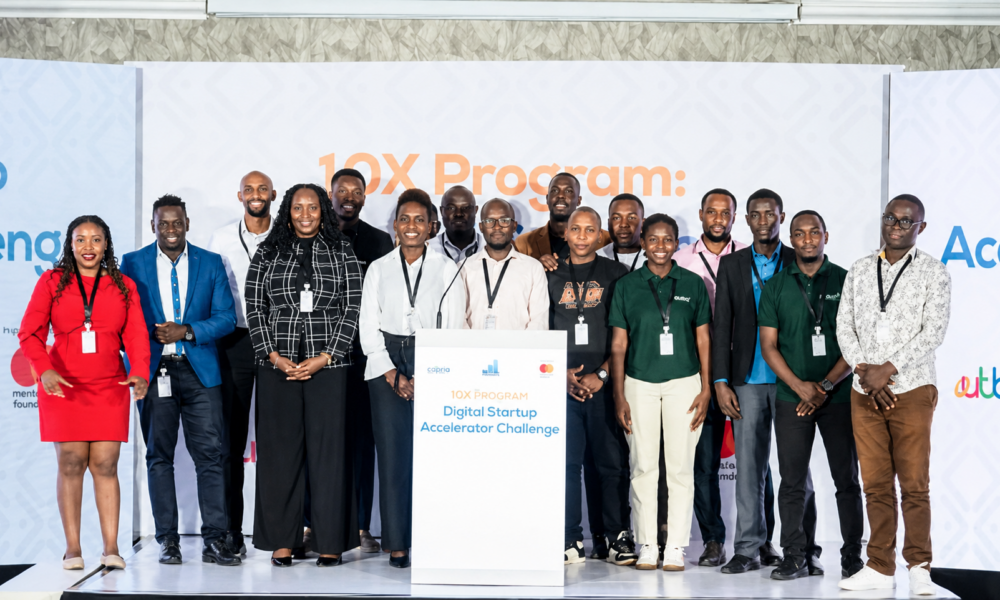
In May 2026, six technology ventures walked out of Kampala’s Mestil Hotel with something that most early-stage Ugandan startups never see: real, structured, institutional-grade early capital, combined with six months of technical assistance, mentorship, and direct connections to mobile network operators and financial institutions.
The six winners of the 10X Digital Startup Accelerator Challenge 2026 each received refundable grants of up to US$40,000, selected from a competitive pool of 78 applicants through a programme implemented by Outbox Uganda in partnership with the United Nations Capital Development Fund (UNCDF) and supported by the Mastercard Foundation. The winning startups are Everpesa Technologies Limited, Everlend Agritech Ltd, Go Use Tech, Smartfric (U) Ltd, Grouppay (Social Pay), and Greenlife Africa.
Richard Zulu, CEO of Outbox Uganda, said these startups are tackling some of Uganda’s most pressing business challenges including access to finance, digital inclusion, market access, and operational efficiency for small businesses. Furthermore, Zulu noted that the broader ambition is to bring more young women entrepreneurs into the digital economy and create stronger locally built technology companies capable of scaling across East Africa.
The Problem These Startups Are Solving
Africa’s technology and fintech sectors have attracted more than US$20 billion in investment over the past decade. The continent’s digital economy narrative has consequently become one of the most compelling in global investment circles. Yet the gap between that headline figure and the lived reality of Uganda’s technology startup ecosystem could not be more stark.
Despite recent policy reforms designed to strengthen the digital finance ecosystem, significant early-stage startup investment is still lacking in Uganda, according to Richard Zulu, Team Lead at Outbox. For most Ugandan founders building locally relevant technology solutions for the country’s millions of micro, small, and medium enterprises, the path from a validated product to meaningful capital has been one of the most persistently difficult journeys in African entrepreneurship.
The 10X Digital Startup Accelerator Challenge was consequently designed as a direct and structured response to this gap. It targets early-stage technology startups building solutions that help Uganda’s MSMEs thrive in the digital economy across agriculture, trade and services, healthcare, light manufacturing, fashion and design, and the meetings, incentives, conferences, and events industry.
The programme specifically targets startups that utilise technology to address device affordability and accessibility challenges for MSMEs, including innovations in financing of smartphones, tablets, and laptops to improve affordability, as well as startups building digital solutions that help MSMEs grow, operate efficiently, and access markets and finance.
Meet the Six Winners
Smartfric (U) Ltd: Making Small Businesses Visible to Finance
Of all the winning startups, Smartfric may be the one whose impact is most immediately legible to anyone who has spent time understanding how Uganda’s informal economy actually works. Ibrahim Kimbugwe and his team have built an offline-first bookkeeping platform that allows small shop owners, market vendors, and informal traders to digitise their financial records without needing a constant internet connection.
The significance of that offline functionality cannot be overstated. A significant portion of Uganda’s small business community operates in areas with unreliable connectivity. Conventional digital bookkeeping tools built for always-on internet environments are consequently useless for precisely the entrepreneurs who need them most. Smartfric was built from the beginning around the realities of its actual users, not the realities of its developers.
Furthermore, the platform’s deeper commercial value lies in what those digital records unlock. A market vendor who has used Smartfric for six months has, for the first time, a verifiable digital transaction history that a bank, a microfinance institution, or a mobile money provider can review when considering a loan application. The bookkeeping software is consequently not just an operational tool. It is a credit-building infrastructure that could transform the financial inclusion trajectory of thousands of small business owners who are currently invisible to formal lenders.
Greenlife Africa: Smartphones as the Gateway to Economic Participation
Greenlife Africa is solving a problem that sits at the very beginning of the digital inclusion journey: access to the device itself. For rural women entrepreneurs across Uganda who lack access to smartphones, the entire ecosystem of mobile money, e-commerce, digital market access, and online business tools is simply unavailable. They are structurally excluded from the digital economy not by their own choices but by a hardware affordability gap that no amount of digital literacy training alone can bridge.
Greenlife Africa addresses this directly by offering rural women access to smartphones through flexible financing arrangements combined with digital literacy training. A rural woman who completes the programme consequently gains not just a phone but the knowledge to use it as a business tool, connecting her to mobile money platforms, online trading marketplaces, and digital financial services that were previously entirely out of reach.
The programme was specifically commended by the 10X Challenge judges for the directness and measurability of its approach to female digital economic empowerment, which aligns closely with the broader 10X Programme’s target of reaching 61,000 young women during its three-year pilot phase.
Everlend Agritech Ltd: Digital Finance for Agricultural Value Chains
For AAN’s readers, Everlend Agritech is perhaps the most directly relevant of the six winning startups. The company is building digital lending infrastructure specifically designed for agricultural value chains, addressing the persistent challenge of credit access that constrains smallholder farmer productivity and agribusiness growth across Uganda’s agricultural sector.
The 10X Programme’s three-year pilot phase aims to reach 61,000 young women, with 34,000 in direct work during this period, with a broader ambition to see more local solutions coming out and being able to scale and attract the kind of financing being seen across the East African region.
Everpesa Technologies, Go Use Tech, and Grouppay
Everpesa Technologies Limited is building digital payment infrastructure for underserved Ugandan businesses, enabling faster and more affordable digital transactions for merchants and their customers. Go Use Tech is developing technology solutions that improve operational efficiency and market access for Ugandan MSMEs across multiple sectors. Grouppay, operating as Social Pay, is building group-based digital payment and savings infrastructure that allows informal savings groups, cooperatives, and community organisations to manage collective finances digitally and transparently.
Together, the six winning startups cover a comprehensive cross-section of the digital infrastructure gaps that limit MSME growth across Uganda, from device access and bookkeeping through to agricultural lending, payment processing, and group financial management.
What the Six Months of Support Looks Like
Winning the 10X Digital Startup Accelerator Challenge is not simply about receiving a grant cheque. The programme’s design is built around the understanding that capital alone is insufficient for early-stage startups in the Ugandan market. What matters equally, or arguably more, is the structured support ecosystem that surrounds the capital.
The selected startups will receive six months of technical assistance, mentorship, and connections to mobile network operators and financial institutions. These connections are consequently among the most valuable elements of the programme, because they provide winning startups with the distribution partnerships and institutional relationships that would otherwise take years of business development effort to establish independently.
For a startup like Smartfric, a direct introduction to a major mobile network operator could mean integration into an existing MSME-facing digital platform, dramatically expanding its reach without requiring the startup to build its own distribution infrastructure from scratch. For Greenlife Africa, connections to financial institutions could unlock the wholesale financing arrangements needed to scale its smartphone financing programme from hundreds of devices to tens of thousands.
Furthermore, the 10X Programme sits within a broader ecosystem that includes the 10X Digitally Empowered Women programme, implemented with dfcu Bank, which has been delivering digital skills training to women entrepreneurs across Uganda’s regional districts including Elgon, Bukedi, Bugisu, Ankole, Acholi, Tooro, Bunyoro, Karamoja, and Central Uganda. The broader 10X Programme is implemented by dfcu Bank in partnership with the United Nations Capital Development Fund (UNCDF), Outbox Uganda, and the Mastercard Foundation.
Why This Matters for Uganda’s Digital Economy
Uganda’s MSME sector is the backbone of the country’s economy. It employs the vast majority of Ugandans outside of formal employment and generates a significant share of domestic economic activity. Yet these businesses have historically operated in a parallel economy, largely invisible to formal financial institutions, disconnected from digital market opportunities, and constrained by the same structural barriers generation after generation.
The 10X Digital Startup Accelerator Challenge consequently matters not because US$40,000 grants are transformative capital at the individual startup level, but because of what they represent systemically. They are an institutional signal that Uganda’s early-stage technology startup ecosystem deserves structured, patient, and locally informed investment support, and that the solutions being built by Ugandan founders for Ugandan MSMEs are commercially viable and development-significant enough to attract backing from globally respected institutions including UNCDF and the Mastercard Foundation.
The 10X Programme aims to train 60,000 young women and link 46,000 youth to digital careers over three years, with Outbox Uganda and UNCDF leading implementation alongside partners including Refactory and Women in Technology Uganda. Furthermore, the programme’s deliberate geographic focus on Uganda’s regional districts beyond Kampala reflects a critical understanding that digital economic inclusion cannot stop at the boundaries of the capital city.
The market vendor in Elgon with a Smartfric bookkeeping account and a Greenlife-financed smartphone is not simply a beneficiary of a development programme. She is, consequently, a new node in Uganda’s digital economy, a customer for financial services, a seller on digital platforms, and a data point in a credit system that was previously entirely blind to her existence.
Disclaimer
Africa Agricultural Network (AAN) is committed to informing and empowering agricultural communities across Africa as per our mandate. This article is intended for informational purposes only. Readers are advised to verify all programme details directly with Outbox Uganda, UNCDF, and the Mastercard Foundation before making any decisions.

No Comment! Be the first one.