

France, Nigeria Launch Agribusiness Club to Drive Investment
France has taken a bold step to deepen its economic ties with Nigeria, unveiling a new platform aimed squarely at unlocking agricultural investment across the West African nation. Consequently, the...

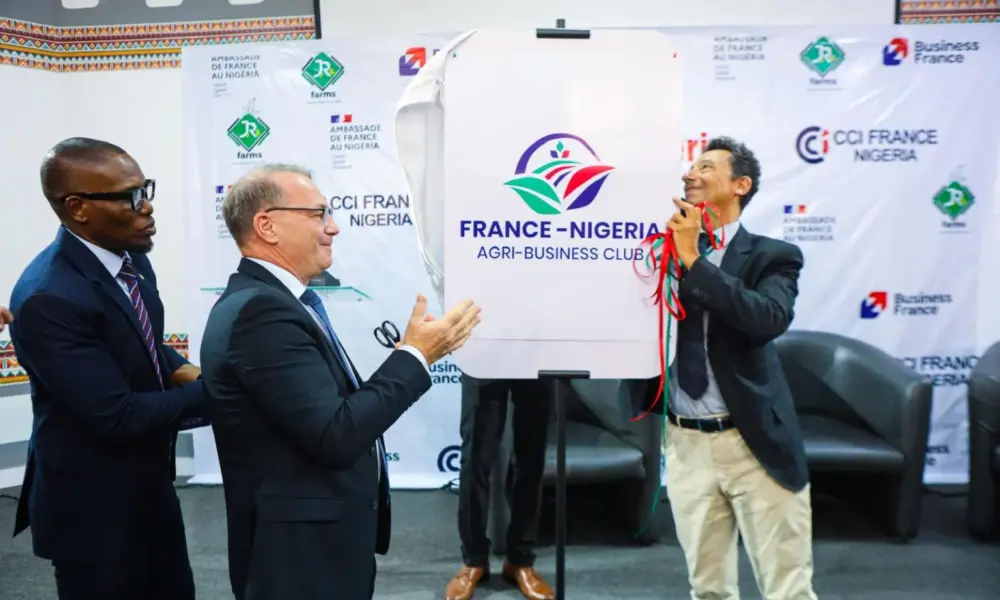
France has taken a bold step to deepen its economic ties with Nigeria, unveiling a new platform aimed squarely at unlocking agricultural investment across the West African nation. Consequently, the France-Nigeria Agribusiness Club was launched in Lagos during the inaugural France-Nigeria Agribusiness Series, bringing together government officials, business leaders, technical experts, and development financiers under one roof.
Table Of Content
The initiative arrives at a pivotal moment as Nigeria seeks fresh capital and technical know-how to turn its agricultural sector into a driver of economic growth. Meanwhile, French officials say the country’s vast farmland, growing population, and untapped export potential make it a natural partner for deeper agribusiness collaboration. As a result, both governments are betting that structured cooperation, rather than scattered efforts, will finally unlock Nigeria’s agricultural promise. This article breaks down what was announced, why it matters, and what happens next.
What Is the France-Nigeria Agribusiness Club?
The France-Nigeria Agribusiness Club is a structured platform designed to connect the Franco-Nigerian business community, the French Embassy, Business France, technical advisers, academic institutions, and development partners. Specifically, it will operate under the umbrella of the Franco-Nigerian Chamber of Commerce and is projected to attract more than 500 members.
Speaking at the launch, France’s Consul General in Nigeria, Laurent Favier, explained that a dedicated forum had long been missing, one where the chamber, technical experts, the embassy, and advisers could sit together and coordinate efforts. The club now formalises coordination, replacing fragmented outreach with a single, unified structure.
Furthermore, Favier noted that combining Nigeria’s agricultural resources with French technical expertise could position the country as one of Africa’s leading agri-food hubs.
Financing Behind the Agricultural Investment Push
Beyond the club itself, France is backing the partnership with real money. Notably, Favier disclosed that France is expanding financial support for African agriculture through its Food and Agriculture Resilience Mission Plus (FARM Plus) initiative, alongside a €300 million facility managed by Proparco, the private-sector financing arm of the Agence Française de Développement group.
Additionally, this facility forms part of a much larger €27 billion commitment announced at the Africa Forward Summit in Nairobi, aimed at accelerating financing for agricultural value chains and agri-food trade across the continent. Proparco has separately confirmed a strong 2025 performance on the continent, having signed close to €1 billion in African private-sector deals, a track record that lends credibility to its new Nigeria-focused commitments.
Tackling Export Barriers: Pests, Contamination, and Standards
Perhaps most practically, the partnership directly targets the technical hurdles that keep Nigerian produce out of European markets. According to Rachid Benlafquih, the Agriculture Counsellor for Nigeria, Ghana, and Cameroon at the French Embassy, France will help Nigerian farmers meet European Union export standards through training, technology transfer, and value-chain development.
To that end, officials from Nigeria’s Federal Ministry of Agriculture and Food Security and the Tomato Producers Association of Nigeria will travel to France to learn biocontrol techniques for combating Tuta absoluta, a pest that has devastated tomato harvests nationwide. Similarly, Benlafquih flagged aflatoxin and Salmonella contamination in sesame and ginger as major obstacles to export competitiveness, adding that France will work alongside Nigerian stakeholders to resolve these issues.
Moreover, he stressed that reducing post-harvest losses, strengthening cold-chain infrastructure, improving veterinary services, and developing Nigeria’s fisheries and blue economy would meaningfully lift agriculture’s contribution to the national economy.
Why Data, Not Just Capital, Matters
Interestingly, the keynote speaker, Professor Olayinka David-West, Dean of Lagos Business School, argued that Nigeria’s agricultural investment gap is less about scarce capital and more about unreliable data. In her view, global investors are ready to deploy funds, yet they routinely struggle to identify bankable agricultural opportunities because of fragmented information systems.
Consequently, she called for joint research programmes, technical fellowships, certification schemes, and co-investment in processing facilities and cold-chain infrastructure, arguing that credible data infrastructure is now investment infrastructure in its own right.
What’s Next for the Partnership
Looking ahead, the France-Nigeria Agribusiness Club plans to grow beyond 500 corporate members, according to organisers. Olawale Rotimi, Convener of the Agribusiness Series and CEO of JR Farms, said the club will coordinate existing partnerships under one unified platform rather than leaving them scattered across different institutions.
Ultimately, business owners and agribusiness operators are being encouraged to plug into this ecosystem early, so they can access technical fellowships, funding pools, and data-driven frameworks as they become available. If implemented well, the combination of French technical expertise and Proparco-backed financing could help Nigerian agribusinesses clear long-standing export hurdles and scale production for both domestic and international markets.
Disclaimer
Africa Agricultural Network (AAN) is committed to informing and empowering agricultural communities across Africa as per our mandate. This article is intended for informational purposes only. Readers are advised to verify all membership details, eligibility requirements, funding terms, and application deadlines directly with the France-Nigeria Agribusiness Club, the Franco-Nigerian Chamber of Commerce, the French Embassy in Nigeria, Proparco, and other relevant organizing bodies before making any investment, partnership, or participation decisions.
No Comment! Be the first one.