


Swedfund Invests $12M in ARAF II for Africa
Africa’s smallholder farmers keep the continent fed, yet they remain among the most exposed to a changing climate. Over 30 million of them operate across Sub-Saharan Africa, producing roughly...

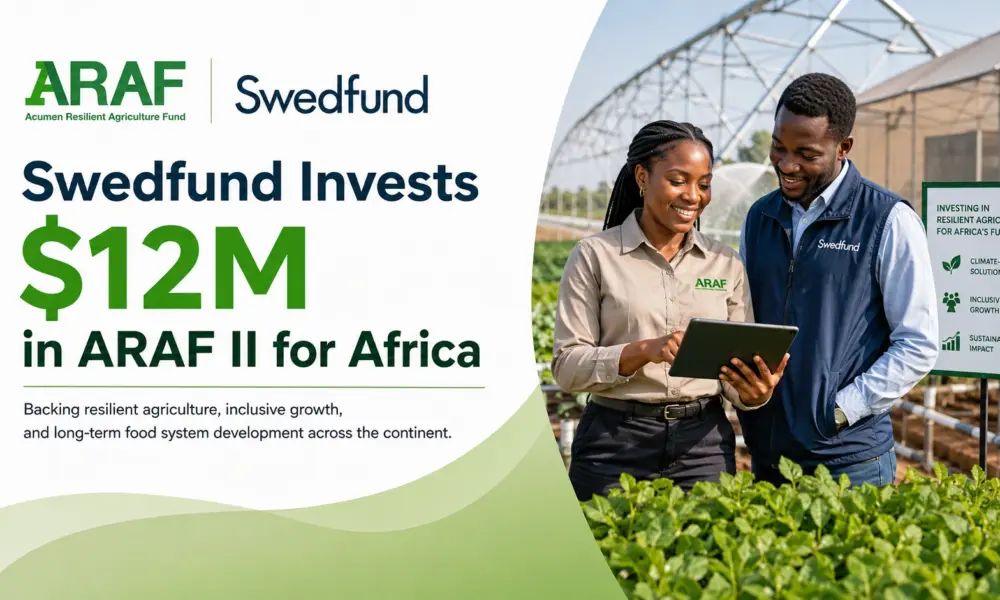
Africa’s smallholder farmers keep the continent fed, yet they remain among the most exposed to a changing climate. Over 30 million of them operate across Sub-Saharan Africa, producing roughly 70% of the region’s food, but persistent gaps in financing, market access, and reliable inputs leave many struggling to withstand droughts, floods, and unpredictable rainfall. Against that backdrop, Swedfund, Sweden’s state-owned development finance institution, has committed US$12 million to the Acumen Resilient Agriculture Fund II (ARAF II). The investment expands financing for agribusinesses working to strengthen climate resilience, market access, and financial inclusion for millions of farmers across the continent. Ultimately, the goal is to help agricultural value chains hold up under mounting climate pressure while giving farmers steadier, more predictable incomes. For a sector where blended finance has become essential to unlocking private capital, this commitment adds fresh momentum to an already growing pool of investors backing climate-smart agriculture in Africa.
Table Of Content
What Swedfund’s Investment Will Support
The financing will back businesses delivering practical, everyday services to smallholder farmers. This includes improved access to agricultural markets, affordable finance, digital technologies, quality farm inputs, and post-harvest infrastructure.
According to Swedfund, the investment is designed to strengthen the resilience of farming communities that remain highly vulnerable to climate variability. At the same time, it aims to improve productivity and help farmers build more stable, sustainable sources of income.
Addressing the Full Value Chain, Not Just the Farm
Notably, Swedfund has framed this investment as an ecosystem-level intervention rather than a narrow, farm-level fix. Rather than targeting isolated interventions, the fund backs businesses capable of strengthening entire agricultural ecosystems, from the point of production to the point of sale.
ARAF II specifically targets enterprises tackling structural bottlenecks across the value chain. These include companies working to reduce post-harvest losses, expand digital agriculture tools, deepen financial inclusion, and improve market integration for smallholder producers.
Why This Investment Matters Now
Helen Hagos, Investment Director for Food Systems and Strategic Investments at Swedfund, has been direct about the urgency behind the commitment. She noted that climate change is already affecting the livelihoods of millions of smallholder farmers across Africa, and that improving their access to markets, finance, and agricultural services is essential for building more resilient food systems.
That framing matters because it positions climate resilience not as a side benefit, but as the central objective. Consequently, ARAF II’s investment thesis rests on a straightforward premise: businesses that solve real structural problems for farmers, rather than offering one-off aid, create resilience that lasts well beyond a single season.
Digital Tools Playing a Growing Role
Furthermore, digital agriculture is emerging as one of the more promising levers within ARAF II’s portfolio strategy. Mobile platforms increasingly give farmers access to real-time market prices, weather forecasts, and agronomic advice, tools that directly inform planting, harvesting, and selling decisions.
Meanwhile, digital payment systems are helping farmers access savings and credit products that were previously out of reach. As a result, technology is becoming a quiet but powerful driver of resilience alongside more traditional financing tools.
A Fund Backed by a Growing Investor Coalition
Swedfund is not investing alone. ARAF II has already attracted commitments from a broadening circle of development finance institutions, including the Green Climate Fund, France’s Proparco, the Netherlands’ FMO, and Belgium’s BIO, alongside the African Agriculture Finance Fund.
This expanding investor base reflects growing institutional confidence in the ARAF model, following the strong track record established by its predecessor fund. Notably, ARAF II also aims to meet the criteria of the 2X Challenge, an initiative promoting investments that advance women’s economic empowerment, adding a gender-focused dimension to its broader climate resilience mandate.
The Bigger Picture for African Agriculture
Ultimately, Swedfund’s $12 million commitment is expected to help ARAF II extend its reach to approximately four million smallholder farmers through its portfolio companies. For a continent where climate shocks increasingly threaten food security, rural incomes, and economic stability, that kind of scale matters.
By channeling patient capital into businesses solving structural problems, rather than offering short-term relief, ARAF II and its growing coalition of backers are betting that resilience, like any other form of infrastructure, is best built one functioning value chain at a time.
Learn More
For more on this investment, read the original announcement from Swedfund. For related coverage of climate-resilient agricultural financing across Africa, see AAN’s earlier reporting on the Acumen Resilient Agriculture Fund’s $90 million raise.
Disclaimer
Africa Agricultural Network (AAN) is committed to informing and empowering agricultural communities across Africa as per our mandate. This article is intended for informational purposes only. Readers are advised to verify all fund details directly with Swedfund and Acumen Capital Partners before making any decisions.




No Comment! Be the first one.