IFC Backs Ghana’s Complete Farmer With $3.06m for Inputs
A farmer who can grow a commercial crop but cannot afford seed and fertiliser in March will still harvest little in September. That timing gap, between when money is needed and when the harvest pays,...

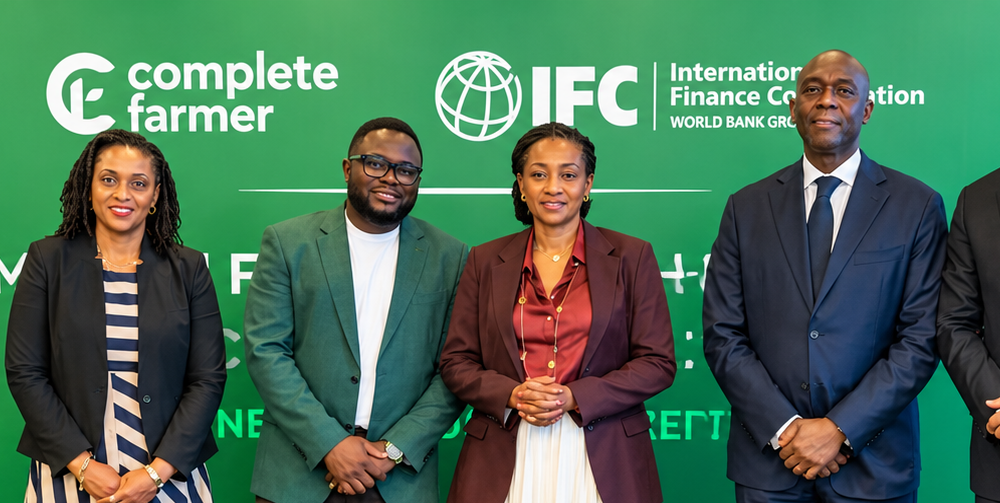
A farmer who can grow a commercial crop but cannot afford seed and fertiliser in March will still harvest little in September. That timing gap, between when money is needed and when the harvest pays, is the problem Ghana’s Complete Farmer is trying to fix.
Table Of Content
In September 2026, the agritech company secured a US$2.4 million convertible loan from the International Finance Corporation (IFC), supported by the Business Investment Financing Track (BIFT) of the Global Agriculture and Food Security Program (GAFSP). Alongside it came about US$660,000 in IFC technical assistance and grant funding, bringing the package to roughly US$3.06 million.
The money will expand input financing and agronomy services. Moreover, the company says the partnership should help it support 240,000 farmers by 2030, up from more than 72,000 today.
This article explains what the package is made of, how Complete Farmer works and why finance for smallholders remains scarce in Ghana. In addition, it compares the deal with funding for Kenya’s Apollo Agriculture, so you can see how farmer-finance models are being backed across Africa.
The Financing at a Glance
Complete Farmer, a Ghanaian agritech company founded in 2017, has secured a US$2.4 million convertible loan from IFC, supported by the Business Investment Financing Track (BIFT), together with about US$660,000 in IFC technical assistance and grant funding. The package totals roughly US$3.06 million and will go towards input financing, agronomy services and links to financial institutions. The company currently reaches more than 72,000 farmers and aims to support 240,000 by 2030.
What the Package Is, and What It Is Not
This is not an equity round led by IFC. A convertible loan is debt that can later convert into ownership, and the terms were not disclosed. As Tech Build Africa noted, conversion could eventually affect who owns the company.
The grant element is smaller but useful. IFC’s technical assistance is meant to strengthen systems and capacity so the company can extend more finance to farmers. Reports differ on its exact size, with one outlet citing US$480,000 for advisory work and others US$660,000, so the total should be treated as approximate.
How Complete Farmer Works
Trading and buyers
Complete Farmer began as an agricultural trading company that links international buyers with smallholder farmers in Ghana and Togo. It supplies buyers that include Aldi and Lidl and runs more than 350 field agents, plus fulfilment centres for aggregation, grading, quality control and export logistics.
Inputs and credit
The company has since added a marketplace for farm inputs and equipment. It also offers a credit product that uses farm data to assess farmers for financing. In other words, it has moved from buying crops to helping farmers pay for the season before it starts.
Why Farmer Financing Matters in Ghana
Farmers across Ghana face a credit shortage. News Ghana reported that agriculture accounted for only 4.7% of bank lending in 2024, and that Bank of Ghana data for mid-2025 put it at about 4.1% of private-sector credit flows, against 76.5% for services. The government has a target of 10% by 2028.
Average lending rates stood at 19.7% in February 2026, according to the same report. Consequently, a farmer borrowing from a bank for inputs faces high costs, while many cannot borrow at all because banks see farming as risky.
CEO Desmond Koney described the gap bluntly. He said many farmers who can grow commercially still struggle to get the financing they need, and that the IFC partnership will help scale the company’s input financing model.
Where BIFT Fits In
BIFT is a US$75 million window created in October 2024 within GAFSP, which the G20 set up in 2010. Its aim is to bring private investment to smallholders and small agrifood businesses that finance markets overlook, using grants and concessional tools to reduce risk.
Its pilot partners include IFC, the African Development Bank, the Asian Development Bank, IDB Invest and IFAD. Therefore, the Complete Farmer deal is an example of public money being used to make a private-sector farmer-finance model easier to scale.
How the Money Builds on Earlier Funding
Complete Farmer has raised money several times before. The company closed a US$10.4 million pre-Series A round in 2023, made up of US$7 million in equity and US$3.4 million in debt, led by the Acumen Resilient Agriculture Fund and Alitheia Capital. It also obtained a US$5 million debt facility from Symbiotics and about €2.2 million, roughly US$2.5 million, from the EU’s AgriFI facility.
Launch Base Africa also reported, citing a US Securities and Exchange Commission filing, that the US parent company had raised about US$9.2 million of a targeted US$12 million equity round. The filing did not name investors, so these figures are not confirmed by the company.
What to Watch Next
Several details are still unclear. The terms of the convertible loan, including interest, maturity and conversion price, have not been published. Moreover, the company has not said how many farmers it currently finances directly, as opposed to serves through its wider platform.
Still, the deal shows how development finance is being used to support commercial farmer-finance models. If Complete Farmer reaches 240,000 farmers by 2030 and repayment holds up, it could become a template for other West African agritechs.
Disclaimer
Africa Agricultural Network (AAN) is committed to informing and empowering agricultural communities across Africa as per our mandate. This article is intended for informational purposes only. Figures and statements referenced were drawn from company announcements and published reports available at the time of writing and have not been independently re-verified by this publication.
No Comment! Be the first one.