


How to Grow and Certify for Export
Uganda has over 404,000 certified organic farmers and exports over $159 million in organic products annually. Learn how to certify your farm and export produce.

Uganda’s Organic Farming Opportunity
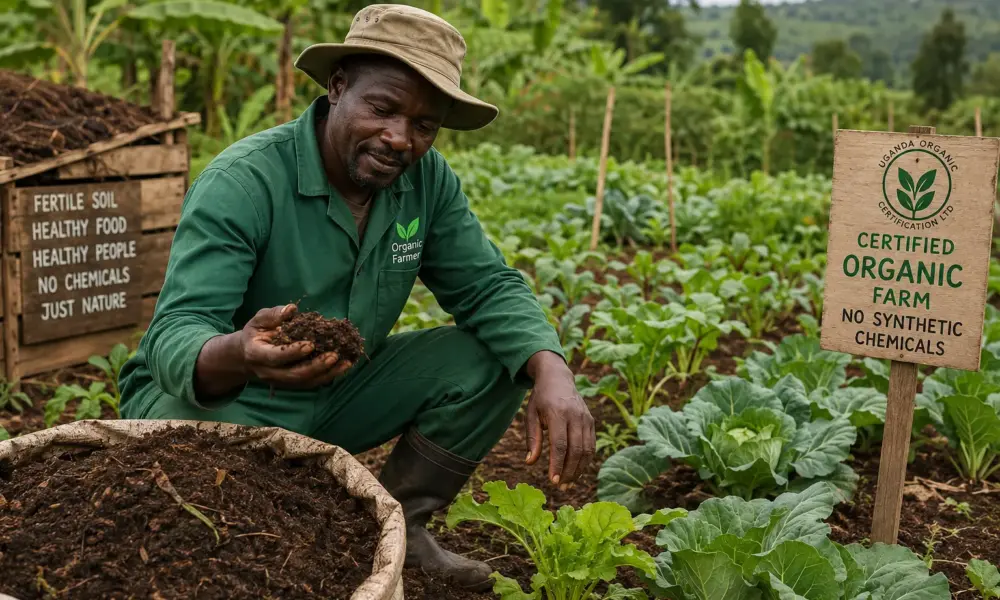
Uganda holds a remarkable distinction in African agriculture. The country is home to one of the largest certified organic farming communities on the continent, with over 404,246 certified organic farmers as of 2025, according to the National Organic Agricultural Movement of Uganda (NOGAMU). That number is growing rapidly, and so is the money attached to it. Uganda’s organic food exports were valued at USD 159 million in 2023, and NOGAMU projected a 40 percent increase in 2024, potentially pushing the figure close to USD 223 million.
Table Of Content
What makes this even more remarkable is how Uganda got here. According to the FAO’s profile of Uganda’s smallholder farmers, more than 70 percent of people in Uganda work in agriculture, with over 3.5 million family farms across the country. A large proportion of these smallholder farmers have historically farmed without synthetic inputs, not by design but by necessity. As a result, the transition to certified organic production is less disruptive for many Ugandan farmers than it would be elsewhere in the world.
Furthermore, the government is actively accelerating the process. Uganda’s National Organic Agriculture Bill 2022 is designed to enhance the sector’s performance, and the Ministry of Agriculture is working with NOGAMU and the Uganda National Bureau of Standards to streamline certification procedures. Nevertheless, the gap between farming without chemicals and farming with internationally recognised organic certification status is real and significant. Understanding that gap is what separates the farmers who earn organic premiums from those who miss out on one of Uganda’s fastest-growing export opportunities.
What Does Organic Farming Actually Mean?
Organic farming is the production of food without the use of synthetic and harmful chemicals, including pesticides, synthetic fertilizers, livestock feed additives, or genetically modified components. Instead, organic farming relies on alternative methods including crop rotation, mechanical cultivation, the use of animal and green manure, composting, and integrated pest management.
In Uganda, certified organic products span a wide and growing range of value chains. They include coffee, tea, cocoa, sesame, chia, sunflower, soybeans, herbs and spices, vanilla, chilli, ginger, shea butter, cotton, fruits, vegetables, meat, dairy products, and poultry products. Additionally, certified value-added organic products such as organic sugar, cooking oil, fruit pulp, juices, dried fruits, roasted and powdered coffee, and cocoa powder are already being exported to the EU, US, Japan, and other global destinations.
Importantly, domestic demand for organic products is also growing. Cereals and pulses, root crops such as cassava and sweet potatoes, yams, and indigenous foods produced without synthetic inputs are increasingly sought after by urban Ugandan consumers. However, as reported by The Organic Standard, currently only about 2 percent of Uganda’s domestic demand for organic products is being met. This represents a significant untapped market opportunity for farmers who certify for both local and export sales.
The Certification Process: What Farmers Need to Know
Step 1: The Three-Year Transition Period
Certified organic production under internationally recognised standards, such as EU Organic and USDA Organic, requires a documented transition period of three years during which no prohibited substances are applied to the land. This transition period is mandatory and cannot be shortened, though it can be formally reduced if a farmer can demonstrate through soil testing and records that the land has already been free from prohibited inputs for the required period.
During the transition period, farmers are encouraged to implement organic practices fully, because the soil health and agronomic improvements achieved during this time directly determine the quality and yield of the first certified harvest. Consequently, farmers who treat the transition period as a genuine investment in their land rather than a waiting period consistently achieve better outcomes at certification.
Step 2: Documentation and Record Keeping
One of the most common reasons Ugandan farmers fail organic certification inspections is poor documentation. International certification standards require farms to maintain clear, dated records of all inputs applied to the land, all harvesting and sales activities, and any incidents that may have affected organic integrity such as spray drift from neighbouring farms.
Therefore, setting up a simple but consistent record-keeping system before applying for certification is not optional. It is a prerequisite. Field books, input purchase receipts, sales invoices, and field maps showing farm boundaries and buffer zones are all typically required at inspection.
Step 3: Choosing a Certification Body
In Uganda, several certification bodies operate nationally and can guide farmers through the process. UGOCERT is Uganda’s primary national organic certification body, established in 2004 by NOGAMU to provide affordable and credible certification services to Ugandan organic producers. It is accredited to certify against both EU and USDA organic standards. Ecocert, an internationally recognised French certification body, also operates in Uganda for export-focused farmers.
Furthermore, the most cost-effective pathway for most smallholder farmers is group certification, where a farmer group or cooperative applies for certification collectively. This approach spreads the cost of inspection and audit across many farms, dramatically reducing the per-farmer certification cost. According to recent reporting by Nile Post (October 2025), Uganda is actively pushing to double its base of certified organic farmers, with the government working to accelerate and simplify certification procedures for both individual farmers and groups.
The Organic Premium: Real Numbers from Real Markets
Certified organic products consistently command premiums of 20 to 50 percent above conventional prices in export markets. In specialty categories, the premiums are substantially higher. Ugandan vanilla commands some of the highest organic premiums in the global spice market when properly certified and traceable. Similarly, certified organic specialty coffee from Uganda’s Mount Elgon and Rwenzori highlands attracts significant interest from European specialty roasters who pay well above standard fair trade prices for documented organic, traceable origin.
However, it is important to be realistic about the transition period. Yields during the first two to three years of conversion may be lower as soil health adjusts and farmers adapt their pest and disease management to organic methods. Consequently, farmers must plan cash flow carefully during this period and ideally access support through farmer groups, extension services, or programmes run by NOGAMU and the Uganda Ministry of Agriculture. Additionally, the National Organic Agriculture Policy, accessible via the Uganda Ministry of Agriculture website, provides a clear regulatory framework for farmers who want to understand their rights and obligations within the certified organic sector.
Key Organic Crops for Ugandan Farmers
Not all crops offer equal returns under organic certification. The following crops represent the strongest export opportunities for Ugandan organic farmers based on current market demand and Uganda’s proven production capacity.
| Crop | Primary export markets | Organic premium potential |
| Coffee (Arabica and Robusta) | EU, USA, Japan, Middle East | 20 to 40% above standard export price |
| Vanilla | EU, USA | Substantial — one of the highest-margin organic spices globally |
| Cocoa | EU, Belgium, Germany | 25 to 50% premium over conventional |
| Sesame | Japan, EU, Middle East | 15 to 30% above conventional price |
| Ginger and chilli | EU, USA, Asia | 20 to 35% premium, growing demand |
| Soybeans | Regional East Africa, EU | 15 to 25% above conventional grain price |
| Fruits and vegetables | Regional markets, EU | Variable, up to 50% for certified produce |
How to Get Started: Practical Next Steps
1. Contact NOGAMU
The National Organic Agricultural Movement of Uganda is the central body for everything related to organic farming in Uganda. Visit nogamu.org or call their Kampala office to begin the conversation. NOGAMU connects farmers, processors, certification bodies, and state representatives to facilitate sustainable growth in the sector. They can guide you on the most appropriate certification pathway for your farm size, crop, and target market.
2. Apply Through UGOCERT
For export-focused certification, UGOCERT (ugocertltd.org) is Uganda’s primary national organic certification body, founded in 2004 and accredited against EU and USDA organic standards. UGOCERT was established as a company owned by NOGAMU specifically to offer affordable and credible certification services to Ugandan organic producers and operators. Their team can walk you through the application process, inspection requirements, and annual renewal procedures.
3. Start Your Transition Documentation Now
Even if you have been farming without synthetic inputs for years, the transition period clock does not officially start until it is formally documented. Therefore, begin keeping dated field records immediately, record every input applied to your land, and photograph your farm boundaries to support the buffer zone requirements that certification inspectors will look for.
4. Build Market Linkages in Parallel
Certification is only one side of the organic export equation. The other side is connecting to buyers who are actively sourcing Ugandan organic produce. Certified exporters, EU import agents, and specialty food companies increasingly seek traceable, certified Ugandan organic commodities. Consequently, engaging with certified exporters and NOGAMU’s market linkage programmes while still in transition means you enter the certified market with a buyer relationship already in place rather than searching for one after the fact.
The Long-Term Case for Organic
Beyond the premium prices, organic farming delivers benefits that compound over time. Healthier soils retain moisture better, reducing vulnerability to erratic rainfall. Lower synthetic input costs improve profit margins even when commodity prices are under pressure. And as consumer awareness of food origins increases globally, Uganda’s organic products are attracting more international buyers every year.
Furthermore, the regulatory environment is strengthening in Uganda’s favour. The National Organic Agriculture Bill 2022 is expected to formalise and accelerate the sector’s growth significantly. The government’s commitment to faster certification procedures and the NOGAMU-UNBS collaboration on value-added product certification means that the pathway from farm to certified organic export is becoming clearer and more accessible than ever. For the full regulatory framework, farmers can consult the Uganda Ministry of Agriculture certification portal to understand exactly what is required to move from farm to export-ready certified organic producer.
For the Ugandan farmer who approaches organic certification strategically, the investment is not just in a premium price. It is in a farming system that becomes more productive, more resilient, and more valuable with every passing season.
Disclaimer
Africa Agricultural Network (AAN) is committed to informing and empowering agricultural communities across Africa as per our mandate. This article is intended for informational purposes only. Readers are advised to verify all details directly with the relevant agricultural organizations before making any decisions.
No Comment! Be the first one.