
Acumen Secures US$90 Million to Scale Climate-Resilient Agriculture Across Africa
Smallholder farmers produce close to 80% of Africa’s food. They are also the people who bear the sharpest consequences of climate change, absorbing the full force of droughts, floods, and...

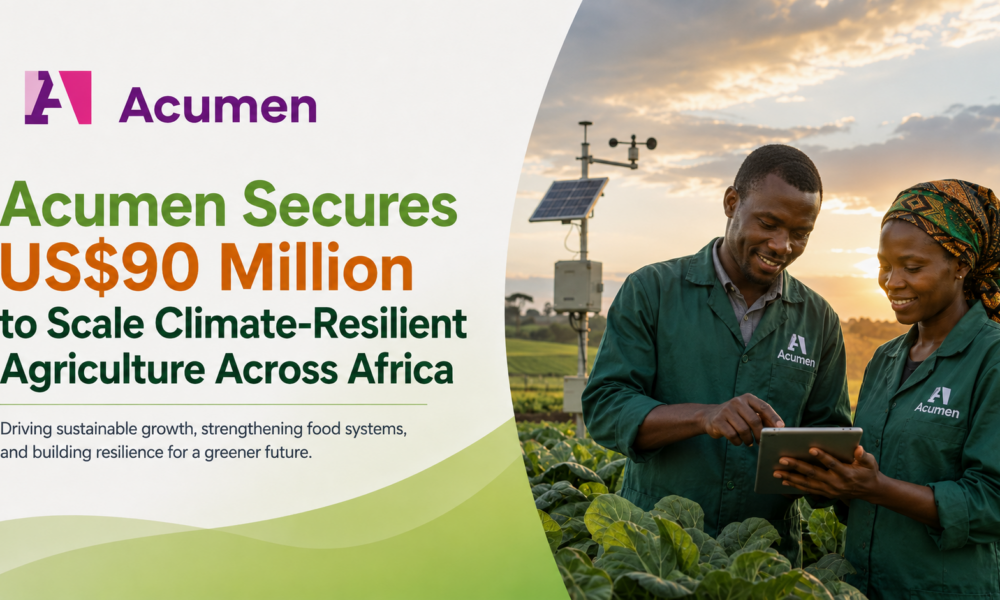
Smallholder farmers produce close to 80% of Africa’s food. They are also the people who bear the sharpest consequences of climate change, absorbing the full force of droughts, floods, and erratic rainfall with few of the financial tools, insurance products, or technological resources needed to recover quickly and plan for the next season.
Table Of Content
Closing that gap between climate exposure and climate resilience for Africa’s smallholder farming communities requires capital. Patient, structured, blended capital that can absorb early-stage investment risk while attracting the private funding needed to back the agribusinesses building practical solutions at scale.
That is precisely what the Acumen Resilient Agriculture Fund (ARAF) was built to provide. And on 16 July 2026, Acumen announced that the fund has secured an additional US$90 million in committed capital, building on the US$58 million already raised and extending its reach beyond East and West Africa into North Africa for the first time since its launch in 2020.
ARAF launched in 2020 as the world’s first equity fund designed to build the climate resilience of smallholder farmers, investing in fast-growing food and agribusinesses that help smallholder farmers adapt to climate change. Furthermore, ARAF has already directly reached more than 3 million smallholder farmers through its 12 portfolio companies, with more than 80% of farmers reporting an increase in income and yield as a result. Its future ambition is to create direct impact for at least four million additional farmers.
For the African agricultural investment ecosystem, this announcement consequently represents one of the most significant blended finance milestones of 2026, demonstrating that climate resilience is not simply a development objective but a commercially viable and institutionally attractive investment thesis.
The Investors Behind the US$90 Million Raise
The breadth and credibility of ARAF’s investor base is one of the most telling indicators of how far the blended finance model for African agricultural climate resilience has matured since the fund’s 2020 launch.
The latest funding round saw continued support from long-standing partners, the Green Climate Fund (GCF), FMO, and Proparco, who have backed ARAF since its inception. They were joined by new investors including Swedfund, BIO, FASA, and a family office, marking a significant expansion of the fund’s investor base.
The Green Climate Fund, which served as the anchor investor in ARAF’s first fund, is increasing its commitment to support the fund’s geographic expansion. Catherine Koffman, GCF Director of the Africa Region, said: “GCF, having served as the anchor investor in ARAF I, through our ongoing partnership with Acumen has demonstrated how blended finance can mobilize private capital for climate-resilient agriculture. Such financing supports innovative agribusinesses and strengthens the resilience of smallholder farmers and agricultural supply chains. GCF is increasing its commitment to expand the fund’s geographic reach and scale up climate-resilient investments for farmers, who are among the most vulnerable to the impacts of climate change.”
FMO, the Dutch entrepreneurial development bank, and Proparco, the French development finance institution, bring established African agricultural investment track records to the fund’s continued backing. The addition of Swedfund International, BIO, and FASA as new investors furthermore signals that the ARAF model is attracting an expanding circle of development finance institutions and impact investors who see commercially viable, climate-focused agricultural investment as a credible asset class, not simply a philanthropic gesture.
Acumen President and Chief Investment Officer Carsten Stendevad said: “ARAF proved that resilience is investable, not theoretical. We are bringing more blended capital and more partners to the table to help smallholder farmers across Africa adapt to a changing climate. This is the kind of capital the moment demands.”
What ARAF Invests In: Four Sectors, One Mission
ARAF invests in businesses developing practical solutions for smallholder farmers, who remain the backbone of Africa’s agricultural sector yet are highly vulnerable to climate change. The fund focuses on four interconnected investment sectors that together create the conditions for comprehensive smallholder climate resilience.
Agricultural Inputs covers businesses providing climate-smart seeds, fertilisers, agrochemicals, and soil management tools that help farmers maintain and improve yields as growing conditions become more unpredictable. Access to the right inputs at the right time and the right price is consequently one of the most direct determinants of whether smallholder farmers can sustain productivity through climate shocks.
Financial Services addresses the critical gap in agricultural finance, insurance, and risk management products available to smallholder farmers. Without access to affordable credit to purchase inputs, insurance to protect against crop failure, and savings products aligned to agricultural income cycles, smallholder farmers have no financial buffer against the climate events that increasingly threaten their livelihoods. ARAF portfolio companies building agri-finance solutions are consequently among the most structurally impactful investments in the fund’s portfolio.
Market Access covers businesses that connect smallholder producers to buyers, processors, and traders, ensuring that productivity gains translate into income improvements rather than being lost to market information asymmetries, transport challenges, and post-harvest losses. Market access businesses are furthermore well-positioned to capture the growing demand for traceable, sustainably produced agricultural commodities from international buyers increasingly subject to the EU Deforestation Regulation and similar sustainability requirements.
Farmer Support covers agronomy advisory services, digital extension platforms, and technical assistance providers that give smallholder farmers the knowledge and guidance needed to adopt climate-smart practices, improve yields, and navigate the increasingly complex regulatory and market environments that define modern agricultural trade.
The North Africa Expansion: A New Frontier for Climate-Resilient Investment
The move into North Africa marks ARAF’s first geographic expansion since launch. It is also, as analysts have noted, a genuine test of whether a blended finance model built around East and West African agribusiness conditions can adapt to a region where farming systems, water constraints, and market structures differ significantly.
Tamer El-Raghy, Managing Director of ARAF, said: “Climate change is a fact of life, and climate resilience for farmers is the difference between a good season and the risk of losing everything. This newly committed capital allows us to continue supporting climate resilience for farmers, while seeking to provide financial returns for our investors as we expand beyond East and West Africa into North Africa, where millions of farmers are affected by climate change.”
North Africa’s agricultural sector faces a distinct and in some respects more severe set of climate pressures than sub-Saharan Africa. Water scarcity is a defining constraint across the region, with declining rainfall, rising temperatures, and increasing pressure on already stressed groundwater resources. The Nile Delta, one of the most agriculturally productive zones in Africa, faces threats from sea level rise and saltwater intrusion that are already affecting soil quality and crop viability. And the region’s geographic proximity to European markets gives North African agricultural exporters both significant commercial opportunity and significant regulatory exposure to the EU’s evolving sustainability and traceability requirements.
For agribusinesses operating across North Africa, ARAF’s expansion consequently offers access to patient, structured equity capital from an investor with a proven track record of backing climate-resilient solutions in the African market, making the fund’s arrival in the region a commercially significant development for the region’s agricultural startup and SME ecosystem.
A Track Record That Justifies the Confidence
The US$90 million raise is not simply a vote of confidence in Acumen’s team or the blended finance model in theory. It is a reflection of ARAF’s documented impact since its 2020 launch.
ARAF launched in 2020 as the world’s first equity fund explicitly designed to strengthen smallholder farmers’ resilience to climate shocks. To date, it has backed 12 fast-growing food and agribusiness companies, and Acumen says the portfolio has directly reached more than 3 million smallholder farmers, with over 80% of them reporting improved incomes and yields.
This 80% income and yield improvement figure is commercially and developmentally significant. It demonstrates that the businesses ARAF invests in are not simply providing services to farmers but genuinely transforming their economic outcomes at a measurable scale. For development finance institutions and impact investors evaluating where to place capital in African agriculture, this track record consequently provides the kind of evidence-based reassurance that has historically been difficult to find in early-stage agribusiness investment.
The fund’s next milestones will likely centre on portfolio company selection in the new North Africa region. Early indicators will show whether the 80%-plus income and yield gains seen elsewhere in its portfolio hold up in new markets.
Why ARAF Matters for Africa’s Agricultural Future
Smallholder farmers produce nearly 80% of Africa’s food, but climate shocks, drought, floods, and erratic rainfall, routinely threaten their livelihoods and regional food supplies. Limited access to finance, inputs, and agronomy support compounds the vulnerability. The fund uses a blended capital structure, with concessional funds designed to absorb early losses and crowd in private money for investments long considered too risky for purely commercial capital.
This blended finance architecture is, in many ways, the most important innovation ARAF represents. Agricultural climate resilience has historically been financed primarily through grants and concessional development aid, which are valuable but inherently limited in scale and sustainability. By demonstrating that equity investment in climate-resilient agribusinesses can generate financial returns alongside development impact, ARAF is building the evidence base that could unlock the far larger pools of private institutional capital that are not accessible through grant-based financing alone.
For the millions of smallholder farmers across East, West, and now North Africa who grow food in increasingly unpredictable conditions, the practical implication of ARAF’s US$90 million raise is that more agribusinesses will receive the capital they need to scale climate-smart solutions, and more farming households will consequently have access to the tools, services, and market connections that can make the difference between a season of loss and a season of recovery.
Disclaimer
Africa Agricultural Network (AAN) is committed to informing and empowering agricultural communities across Africa as per our mandate. This article is intended for informational purposes only. Readers are advised to verify all fund details directly with Acumen Capital Partners before making any decisions.



No Comment! Be the first one.