

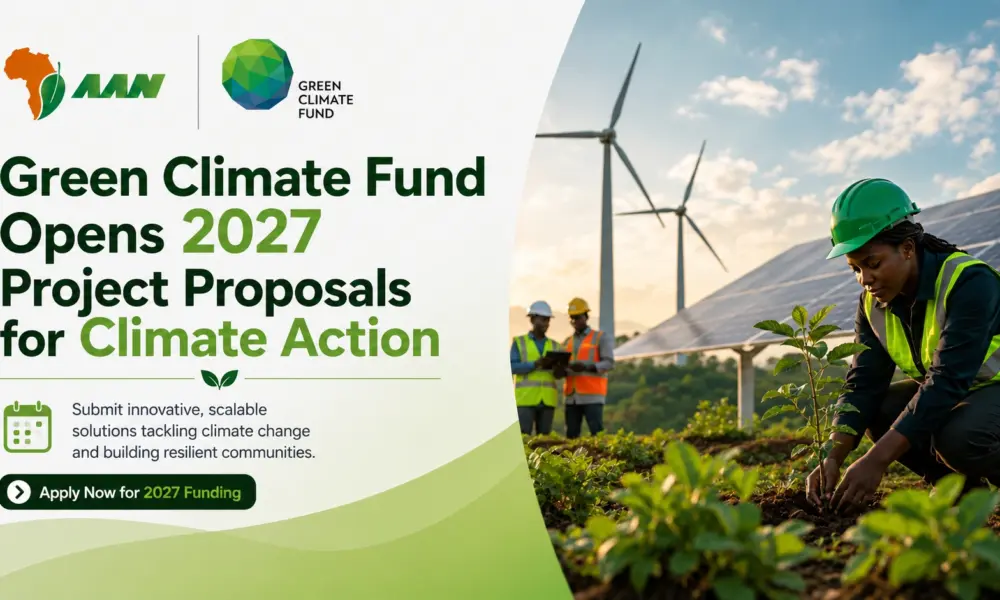
Green Climate Fund Opens 2027 Project Proposals for Climate Action 🌍🌱
Climate change is no longer a future threat for Africa’s farming communities. It is reshaping when rains fall, how severe droughts become, and how predictably smallholder farmers can plan...

Climate change is no longer a future threat for Africa’s farming communities. It is reshaping when rains fall, how severe droughts become, and how predictably smallholder farmers can plan across seasons growing increasingly unpredictable. The financial response to that reality has never been more urgently needed.
Table Of Content
The Green Climate Fund (GCF), the world’s largest dedicated climate finance mechanism established in 2011 by 194 governments under the UNFCCC, is now inviting new project proposals for 2027, creating one of the most significant climate funding opportunities currently available to governments, development organisations, agribusinesses, and accredited entities working across the developing world.
For African organisations working at the intersection of climate action and agricultural development, this call is consequently one of the most important windows to act on this year.
What the GCF Funds
The 2027 call supports projects across five core areas that are directly relevant to Africa’s agricultural and development priorities.
Climate Adaptation helps vulnerable communities and farming systems build resilience against climate impacts already being experienced, including erratic rainfall, prolonged droughts, and flooding. For Africa’s smallholder farmers, adaptation funding is consequently among the most immediately transformative climate finance available.
Sustainable Agriculture sits at the heart of the GCF’s Africa portfolio. Recent approvals include a Green Climate Finance Facility for climate-smart agriculture in Senegal, a USD 70 million project to build agroecosystem resilience in Ghana, and the RE-GAIN initiative to scale food loss reduction in Africa in partnership with AGRA.
Renewable Energy supports solar, wind, hydro, and clean energy transitions. For Africa’s agricultural sector, renewable energy directly enables solar irrigation, cold chain infrastructure, and off-grid processing technology that improve both productivity and climate resilience.
Climate Mitigation reduces greenhouse gas emissions across agriculture, land use, and energy systems, increasingly relevant as international markets and frameworks such as the EU Deforestation Regulation demand deforestation-free and low-carbon supply chains.
Climate-Resilient Infrastructure funds water management systems, early warning infrastructure, and the physical systems that protect communities and economies from escalating climate impacts.
Who Can Apply
The GCF works exclusively through accredited entities. These include international organisations such as the African Development Bank, FAO, UNEP, UNDP, and IFAD, as well as national direct access entities, regional bodies, development finance institutions, and private sector organisations working through an accredited partner.
The Fund targets a 50:50 balance between mitigation and adaptation investments and maintains a floor of 50% of the adaptation allocation specifically for Least Developed Countries, Small Island Developing States, and African States, making it structurally one of the most Africa-relevant climate finance mechanisms in existence.
For organisations not yet accredited, the GCF Readiness and Preparatory Support Programme provides technical assistance to strengthen institutional capacity and engagement with the Fund.
Why This Matters for Africa
Africa hosts 25% of global biodiversity yet receives less than 3% of global climate finance relative to its needs. Its agricultural sector employs the majority of the working population across most sub-Saharan African countries and is simultaneously the most climate-exposed and most economically critical sector on the continent.
The 2027 GCF call consequently arrives at a moment when African governments and organisations are more urgently in need of climate finance than at any previous point in recent history. For those with the institutional capacity and accreditation to engage, this is one of the most strategically significant funding opportunities currently open anywhere in the global development landscape.
How to Apply
Proposals follow a two-stage process beginning with a concept note submission, followed by a full funding proposal reviewed by the GCF Secretariat and Board. Organisations are encouraged to engage their National Designated Authority and begin concept note development as early as possible.
Disclaimer
Africa Agricultural Network (AAN) is committed to informing and empowering agricultural communities across Africa as per our mandate. This article is intended for informational purposes only. Readers are advised to verify all details directly with the Green Climate Fund Secretariat before making any decisions.




No Comment! Be the first one.