

Ecobank Lists World’s First Nature Bond, Raising US$450M for Africa’s Agriculture and Ecosystems 🌿💚
Ecobank Lists World's First Nature Bond, Raising US$450M for Africa's Agriculture and Ecosystems 🌿💚

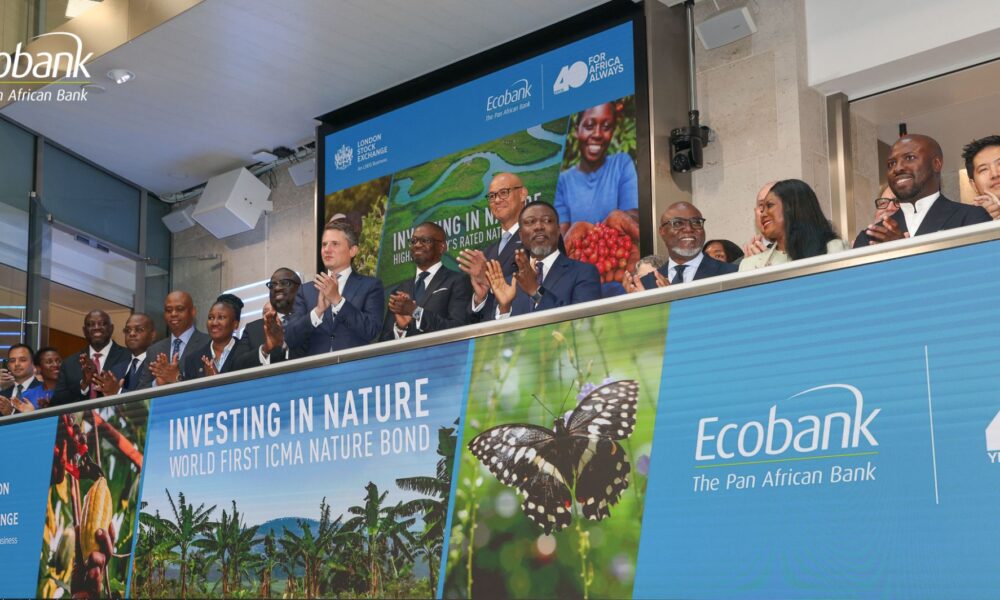
Something historic happened on the floor of the London Stock Exchange in June 2026. Ecobank Transnational Incorporated, the Lomé-based parent of Africa’s most geographically expansive pan-African banking group, rang the opening bell to mark the successful listing of a financial instrument that has never existed before in the history of global capital markets.
Table Of Content
- A Bond That Investors Could Not Get Enough Of
- What the Bond Will Finance: Agriculture, Nature, and Water
- Sustainable Primary Production
- Sustainable Agri-Processing
- Water Supply, Sanitation, and Irrigation
- Why 81% of the Eligible Pool Goes to Biodiversity-Critical Countries
- Four Years of Building Credibility: The Story Behind the Bond
- What This Means for Africa’s Agricultural Financing Future
The US$450 million Sustainable Agriculture and Natural Capital Bond, now listed on the main market of the London Stock Exchange, is the world’s first ICMA-designated Nature Bond issued by a commercial bank. It is the first use-of-proceeds green bond anywhere in the world to carry the International Capital Market Association’s Nature Bond secondary designation. And it is, consequently, one of the most significant milestones in the history of African sustainable finance.
For Africa’s agricultural sector, the significance of this moment extends well beyond the financial mechanics of a bond issuance. Africa hosts 25% of global biodiversity yet receives less than 3% of nature finance. The Ecobank Nature Bond is a direct, structural, and commercially validated response to that imbalance, creating for the first time a credible, scalable, and internationally listed mechanism for channelling private capital into the protection and sustainable development of Africa’s natural and agricultural ecosystems.
Jeremy Awori, Group Chief Executive Officer of Ecobank Transnational Incorporated, captured the magnitude of the moment: “Investors did not just support this bond. They demanded more of it. We have spent four years building the systems, governance, and accountability needed to make nature finance credible and scalable in Africa.”
A Bond That Investors Could Not Get Enough Of
The market’s response to the Ecobank Nature Bond was immediate and emphatic. The transaction attracted strong fixed-income investor demand, with the final order book reaching more than US$1.36 billion, representing 3.9 times oversubscription on the original target size of US$350 million, enabling Ecobank to upsize the notes by US$100 million to US$450 million and tighten pricing by 50 basis points.
Final allocations were distributed approximately 55% to the UK and Europe, 38% to Africa, 3% to the Middle East, 2% to the US, and 2% to Asia, with participation from development finance institutions and dedicated sustainability-focused funds. Furthermore, FMO, the Dutch entrepreneurial development bank, placed a US$50 million anchor order, marking the second consecutive Tier 2 capital transaction in which FMO served as anchor investor, following its US$50 million anchor order in Ecobank’s inaugural US$350 million Tier 2 Sustainability Notes in June 2021.
The oversubscription rate is consequently not simply a testament to Ecobank’s institutional creditworthiness. It is a powerful market signal that global investors are ready, willing, and actively seeking credible opportunities to back climate action, nature protection, and agricultural transformation in Africa simultaneously through a single, commercially structured instrument.
Moody’s Ratings awarded the transaction a Sustainability Quality Score of 1 (SQS1), rated Excellent, the highest possible score ever assigned to a pan-African commercial bank. This independent validation from one of the world’s most respected credit rating agencies confirms that the rigorous governance, accountability frameworks, and verification mechanisms Ecobank has built around this bond meet the highest international standards for sustainable finance quality.
What the Bond Will Finance: Agriculture, Nature, and Water
The proceeds from the Ecobank Nature Bond are not directed toward abstract environmental commitments or distant conservation programmes. They are channelled directly and deliberately into Africa’s real economy, financing the farmers, agribusinesses, processors, and water infrastructure managers whose daily activities shape environmental outcomes at the most meaningful and immediate scale.
The bond is designed to support eligible lending across three categories: Sustainable Primary Production, Sustainable Agri-Processing, and Water Supply and Sanitation, in 24 markets within Ecobank’s operating footprint, with lending concentrated in nature and biodiversity-priority markets.
Sustainable Primary Production
The first and largest category of eligible lending supports smallholder farmers and commercial agricultural producers who are adopting sustainable farming practices. This includes farmers transitioning to lower-input production methods, integrating agroforestry, improving soil health management, and building climate resilience into their production systems. For the millions of smallholder farmers across Ecobank’s 24 eligible markets who have historically lacked access to affordable, long-term agricultural finance, this category of lending consequently represents a direct and meaningful improvement in their ability to access capital on commercially viable terms.
Sustainable Agri-Processing
The second category targets agri-processors operating verified deforestation-free supply chains. As European and international buyers increasingly require supply chain traceability and deforestation-free certification as prerequisites for market access, Ugandan and African agri-processors that can demonstrate compliance with these standards gain access to premium markets and better pricing. The Ecobank Nature Bond consequently provides the financing infrastructure that enables more African processors to meet these requirements while simultaneously protecting the forest ecosystems on which their supply chains depend.
Water Supply, Sanitation, and Irrigation
The third category funds water infrastructure projects that protect freshwater ecosystems relied upon by millions of people across the continent. Agriculture remains one of Africa’s largest employers and a critical source of income for millions of households. However, unsustainable land-use practices continue to contribute to deforestation, biodiversity decline, and soil degradation across many parts of the continent. By directing capital into water management infrastructure, the Nature Bond addresses the environmental dimension of agricultural development that is most frequently underfunded by conventional agricultural finance instruments.
Why 81% of the Eligible Pool Goes to Biodiversity-Critical Countries
The geographic targeting of the Ecobank Nature Bond reflects a rigorous evidence-based approach to capital allocation that distinguishes it from many sustainable finance instruments that are broader in their environmental objectives.
Importantly, 81% of the eligible lending pool is allocated to countries where agricultural land-use change is the primary driver of biodiversity loss, helping direct capital to the areas where it can have the greatest environmental impact. Priority deployment countries include Côte d’Ivoire, Burkina Faso, and Ghana, where the intersection of rapid agricultural expansion and critical biodiversity hotspots makes targeted sustainable finance both most urgent and most impactful.
Each eligible loan under the framework is subject to seven independently verified sustainability conditions, including deforestation screening and supply chain traceability requirements. This level of independent verification consequently ensures that every loan financed through the Nature Bond generates real, measurable, and auditable nature-positive outcomes rather than simply fulfilling a paper commitment to environmental responsibility.
Rachael A.O. Antwi, Group Head of Sustainability and Environmental and Social Risk Management at Ecobank, articulated the philosophy behind this approach with clarity and conviction. “Nature finance in Africa has too often been discussed far from the communities and environments it is meant to support. This bond helps change that. Nature finance will only scale in Africa if it is practical, measurable, and connected to the real economy. This bond is designed to do that by linking international capital to eligible lending for sustainable agriculture and water infrastructure across 24 countries.”
Four Years of Building Credibility: The Story Behind the Bond
The Ecobank Nature Bond did not emerge from a single transaction decision. It is the product of four years of deliberate, systematic investment in the governance, data, and accountability infrastructure needed to make nature finance credible and scalable at an African commercial banking institution.
The transaction serves two strategic purposes for Ecobank. First, it supports liability management by refinancing the 2021 Tier 2 Sustainability Notes ahead of their June 2026 call date. Second, it deepens the group’s sustainable finance positioning at a time when banks across Africa are under pressure to mobilise capital for climate resilience, agriculture, water infrastructure, and natural capital preservation.
Ayo Adepoju, Group Chief Financial Officer of Ecobank Transnational Incorporated, noted that the transaction validated both the group’s credit strength and the quality of its sustainability architecture. “By refinancing our 2021 Tier 2 Sustainability Notes ahead of their June 2026 call date and upsizing to US$450 million in the same transaction, we have executed a clean liability management exercise while simultaneously advancing our sustainable finance programme,” he said.
The bond’s institutional backing is equally significant. Ecobank Transnational Incorporated acted as Issuer, Originator, and Sole Sustainability Structuring Adviser, with Standard Chartered Bank and Renaissance Capital Africa acting as Joint Lead Managers and Joint Bookrunners. This combination of Ecobank’s deep African market knowledge, Standard Chartered’s global distribution network, and Renaissance Capital’s Africa-focused investor relationships consequently created the optimal structure for attracting both international and African capital into a single, credibly constructed sustainable finance instrument.
What This Means for Africa’s Agricultural Financing Future
The Ecobank Nature Bond is not simply a landmark transaction. It is a proof of concept for an entirely new class of financing instruments that could fundamentally change how private capital flows into African agriculture, food systems, and ecosystem management.
For decades, the argument that Africa’s agricultural and natural capital sectors were too risky, too opaque, or too structurally complex to attract institutional-grade international capital has been used to justify the chronic underinvestment that has constrained agricultural productivity, ecosystem health, and rural livelihoods across the continent. The successful issuance signals growing confidence among global investors in the continent’s ability to deliver credible, transparent, and impactful environmental investments.
Furthermore, as AGRA has noted in its celebration of this milestone, the continent needs much more innovative financing like this to build resilient and sustainable agrifood economies across Africa. The Ecobank Nature Bond consequently demonstrates that the financial architecture for such innovation is not a distant aspiration. It is being built, listed, and backed by nearly four times the initial capital target, right now.
Disclaimer
Africa Agricultural Network (AAN) is committed to informing and empowering agricultural communities across Africa as per our mandate. This article is intended for informational purposes only. Readers are advised to verify all financial details directly with Ecobank Transnational Incorporated before making any decisions.
No Comment! Be the first one.