
Smart Africa and FAO Open US$50,000 AI Agriculture Challenge
Africa’s agricultural sector feeds nearly a billion people. It employs the majority of the continent’s workforce. And it is under increasing pressure from a climate that is becoming...

Africa’s agricultural sector feeds nearly a billion people. It employs the majority of the continent’s workforce. And it is under increasing pressure from a climate that is becoming measurably less predictable, more extreme, and more disruptive with every passing season. Droughts arrive earlier. Rains fail or flood. Pests migrate into new zones. And the smallholder farmers who grow most of Africa’s food are navigating these challenges with the least access to the information, technology, and financial tools they need to respond effectively.
Table Of Content
Artificial intelligence is changing what is possible for these farmers. And right now, one of the continent’s most credible and well-supported innovation platforms is actively searching for the AI solution that can make the biggest difference.
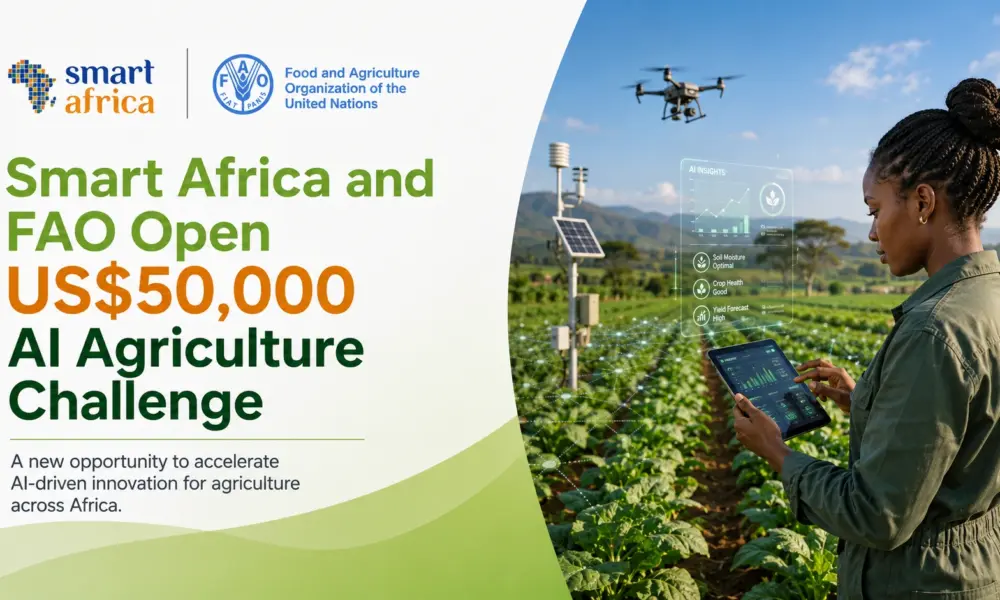
The Innovate Africa Challenge, 3rd Edition, launched by Smart Africa in partnership with the Food and Agriculture Organization of the United Nations (FAO), is now open for applications, offering US$50,000 to support the deployment, validation, and scaling of a proven AI-driven solution for Climate-Smart Agriculture across Africa. Applications close on 31 August 2026.
Under the theme From Ideation to Deployment, this edition is explicitly focused on moving beyond ideas and prototypes to support practical and scalable solutions that deliver measurable benefits for farmers in real-world agricultural contexts.
What Is the Innovate Africa Challenge?
Smart Africa is a bold and innovative alliance of African heads of state and government, the African Union Commission, and leading public and private sector organisations committed to the harnessing of ICT for the development and transformation of the African continent.
The Innovate Africa Challenge is one of Smart Africa’s flagship innovation programmes, identifying and supporting technology solutions that address Africa’s most pressing development challenges across agriculture, climate resilience, and digital inclusion. Previous editions of the challenge have supported AI solutions ranging from solar-powered robotic pest detection systems capable of accurately identifying more than 12,000 crop pests and pathogens, to AI-powered weather station solutions providing real-time data for sustainable agriculture and enhanced crop yields, to AI forecasting systems optimised for tropical and subtropical regions with double the accuracy of global climate models.
The partnership with FAO brings institutional depth and global agricultural expertise to the challenge’s design, selection criteria, and post-award support framework. FAO has been building a comprehensive digital agriculture and AI innovation ecosystem that includes regional Digital Agriculture Innovation Hubs, a Global AgriInno Challenge, and an AI Innovation Roadmap making its partnership with Smart Africa on the Innovate Africa Challenge a natural extension of its continental digital agriculture strategy.
Furthermore, the FAO’s position as the United Nations’ lead agency on global food security gives the Innovate Africa Challenge an institutional credibility and international visibility that most African innovation competitions cannot match, significantly amplifying the potential reach and impact of the solution that wins the 2026 edition.
The 2026 Theme: From Ideation to Deployment
The deliberate choice of From Ideation to Deployment as the 3rd Edition’s guiding theme is a signal that deserves careful attention from anyone planning to apply.
Africa’s agricultural innovation landscape has no shortage of compelling ideas or early-stage prototypes. What it consistently lacks is the structured support, real-world validation, and scaling capital needed to move proven solutions from controlled pilots into the hands of the millions of farmers who need them. Too many agricultural AI solutions that work in demonstration settings never make the journey to deployment at meaningful scale because of gaps in funding, technical validation, market navigation, and institutional partnership.
The 3rd Edition of the Innovate Africa Challenge is consequently designed to address exactly that gap. It is not looking for the most innovative concept or the most technically sophisticated algorithm. It is looking for a solution that already works, has evidence of real-world agricultural impact, and has the potential to scale across African farming contexts with the right deployment support and validation resources behind it.
This focus consequently makes the challenge particularly relevant for AI agricultural innovators who have moved through the early stages of development and validation and are now looking for the institutional support and capital needed to reach the next level of impact.
What Problems the Challenge Wants AI to Solve
The 3rd Innovate Africa Challenge is focused on AI solutions that address Africa’s most pressing agricultural and climate challenges. The range of problems the challenge is seeking solutions to is broad and reflects the full complexity of what climate change is doing to African farming systems.
Crop forecasting and yield prediction using AI to help farmers anticipate production outcomes, plan input purchases, and engage with buyers with greater confidence about what they will harvest and when.
Pest and disease detection applying computer vision, machine learning, and satellite imagery to identify crop threats early, allowing farmers to respond before damage becomes catastrophic. Innovators like Tafadzwa Chikwereti of eAgro in Zimbabwe have already demonstrated what is possible, with CropFix using AI to diagnose pests, diseases, and nutrient deficiencies from photos taken directly by farmers on their mobile phones.
Water use optimisation using precision irrigation technologies, soil moisture sensing, and AI-driven water management systems to help farmers maintain productivity while reducing water consumption in increasingly water-stressed agricultural environments.
Climate resilience and adaptation advisory through AI platforms that provide farmers with real-time, location-specific climate information, planting advice, and risk management guidance that helps them make better decisions in the face of increasingly unpredictable weather conditions.
Agricultural supply chain and market access using AI to improve post-harvest handling, reduce food losses, connect farmers to buyers, and strengthen the market information systems that allow smallholders to negotiate better prices for their produce.
The US$50,000 Award: What It Covers
The selected solution will receive US$50,000 specifically structured to support three interconnected objectives that reflect the From Ideation to Deployment theme.
Deployment support covers the technical and operational costs of taking a validated AI solution to new geographies, farming contexts, or scales of implementation. For many agricultural AI innovators, the transition from a single-country or single-crop pilot to multi-country or multi-crop deployment requires infrastructure investment, software adaptation, and partnership development that the US$50,000 is designed to enable.
Validation activities cover the rigorous real-world testing needed to document impact, build the evidence base that attracts future investment and institutional adoption, and demonstrate that the solution’s performance in controlled pilots translates into measurable farmer outcomes under diverse field conditions.
Scaling pathways cover the business development, partnership negotiation, and market entry activities needed to build the commercial and institutional relationships that can carry the solution beyond the challenge period into long-term, self-sustaining deployment.
Beyond the US$50,000, the Innovate Africa Challenge winner gains access to something equally valuable: the institutional networks, visibility, and credibility that come from being publicly endorsed by Smart Africa and FAO as the continent’s leading AI solution for Climate-Smart Agriculture in 2026.
Why AI in African Agriculture Is Having Its Defining Moment
The timing of the 3rd Innovate Africa Challenge reflects a broader convergence of factors that are making artificial intelligence in African agriculture not just possible but increasingly essential.
FAO Director-General Qu Dongyu, speaking at the AI for Good Summit in Geneva in July 2026, highlighted the transformative potential of AI in advancing food security and building climate-resilient agriculture, while warning that the digital divide risks becoming a development divide if AI solutions do not reach the farmers and rural communities that need them most.
Africa’s agricultural sector is, in many respects, uniquely well-positioned to benefit from AI-driven solutions. The continent’s smartphone penetration is growing rapidly, creating distribution pathways for mobile-based advisory tools. Satellite imagery and remote sensing data are increasingly available at high enough resolution to enable meaningful crop monitoring at the field level. And the scale of the agricultural productivity challenge on the continent creates strong commercial incentive for innovators who can deliver measurable farmer impact.
Furthermore, the institutional landscape supporting agricultural AI in Africa has never been stronger. The Green Climate Fund, ARAF, the World Bank, and dozens of development finance institutions are actively seeking to finance the scaling of proven agricultural technology solutions. The Innovate Africa Challenge consequently offers innovators a pathway to demonstrate that proof, backed by the institutional credibility of Smart Africa and FAO, that can open doors to the follow-on capital and partnership needed for genuinely continental impact.
How to Apply
Applications for the 3rd Innovate Africa Challenge are submitted through the Smart Africa official application portal. The deadline is 31 August 2026. Applicants should be prepared to demonstrate a proven AI solution for Climate-Smart Agriculture with documented real-world agricultural impact, a clear deployment and scaling plan, and the organisational capacity to execute that plan with the support of the US$50,000 award.
Organisations that have already demonstrated early impact but need validation support and deployment capital to move to the next level of scale are consequently the most competitively positioned applicants for this edition’s From Ideation to Deployment mandate.
Disclaimer
Africa Agricultural Network (AAN) is committed to informing and empowering agricultural communities across Africa as per our mandate. This article is intended for informational purposes only. Readers are advised to verify all challenge details, eligibility criteria, and application requirements directly with Smart Africa and FAO before making any decisions.


No Comment! Be the first one.