
3rd National Seed Congress Convenes in Kigali This July.
Every crop that feeds a family, generates farm income, or drives agricultural export revenue begins with a single decision: the seed. The variety chosen, the quality of the genetic material, and the...

Every crop that feeds a family, generates farm income, or drives agricultural export revenue begins with a single decision: the seed. The variety chosen, the quality of the genetic material, and the reliability of the supply chain that delivers it to the farmer’s hand before planting season opens, these are not secondary agricultural considerations. They are the foundation on which everything else in the agricultural value chain is built. Get the seed right and the yield, the income, and the food security follow. Get it wrong, and no amount of fertiliser, irrigation, or market access can fully compensate.
Table Of Content
- From First Congress to Third Edition: Rwanda’s Seed Sector Journey
- The 2026 Theme: Seeds as a Strategic Engine for National Transformation
- Rwanda’s Seed Sector: The Challenges the Congress Must Address
- Who Will Attend and What the Congress Will Discuss
- Rwanda’s Broader Agricultural Transformation Context
- Why This Congress Matters Beyond Rwanda’s Borders
- How to Register and Participate
It is this foundational understanding that has driven Rwanda’s National Seed Congress from a single inaugural event in 2023 into one of the most important recurring agricultural policy and industry platforms in East Africa. And on 20 and 21 July 2026, the conversation continues at its most ambitious edition yet.
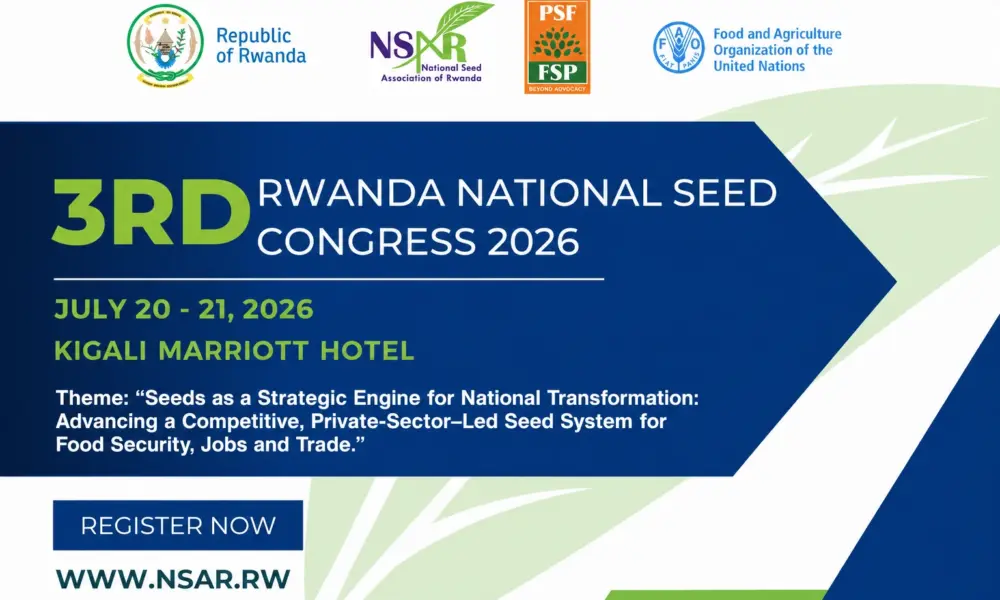
The 3rd Rwanda National Seed Congress 2026 will be held at the Kigali Marriott Hotel, Kigali, Rwanda, under the theme “Seeds as a Strategic Engine for National Transformation: Advancing a Competitive, and Private-Sector-Led Seed System for Food Security, Jobs and Trade.” It is being organised by the National Seed Association of Rwanda (NSAR) in collaboration with the Government of Rwanda and the Private Sector Federation (PSF), with support from different development partners, and intends to position Rwanda as a key seed industry player in the region and worldwide.
Furthermore, the 2026 congress arrives at a pivotal moment for Rwanda’s agricultural sector, as the country advances implementation of its Strategic Plan for Agriculture Transformation (PSTA5) and its broader National Strategy for Transformation (NST2), both of which identify seed system development as a critical enabler of the productivity gains, private sector investment, and export market access that Rwanda’s agricultural transformation agenda requires.
From First Congress to Third Edition: Rwanda’s Seed Sector Journey
To understand the significance of the 2026 congress, it helps to trace the journey that began three years ago in the same city.
The inaugural Rwanda National Seed Congress took place in Kigali from 31 July to 1 August 2023, themed “Private Sector Strategic Roadmap for the Seed Industry 2030.” It marked a significant milestone for the country’s seed industry, bringing together key stakeholders from the government, public, and private sectors to address challenges and opportunities in the national seed value chain. Discussions centred around the Rwandan National Seed Strategic Roadmap, which provides a comprehensive plan to steer the industry toward sustainable growth.
The first congress furthermore generated a set of concrete recommendations that continue to shape Rwanda’s seed sector policy. The government was encouraged to seek accreditation with major seed industry quality organisations such as the International Seed Testing Association (ISTA) and OECD certification schemes, while the empowerment of NSAR as an advocate and facilitator for the seed industry was highlighted as an essential measure. Public-private partnerships were identified as critical to promoting Rwanda as a seed production and trade investment destination.
The second congress in July 2024 built on those foundations, deepening the technical conversations and expanding stakeholder participation. Consequently, the 2026 third edition arrives with three years of institutional momentum, documented outcomes, and a growing private sector ecosystem behind it, making it by far the most consequential edition of the congress to date.
The 2026 Theme: Seeds as a Strategic Engine for National Transformation
The choice of theme for the 2026 congress is deliberate and strategically significant. Seeds as a Strategic Engine for National Transformation positions the seed sector not as a technical agricultural input discussion but as a national economic development conversation. This framing reflects a maturing understanding within Rwanda’s policy and private sector communities that seed system quality, competitiveness, and regional trade positioning are directly linked to the country’s broader ambitions for agricultural transformation, job creation, and export revenue growth.
NSAR’s Chairperson, Innocent Namuhoranye, has described the congress as a platform to showcase the role of the private sector in Rwanda’s seed ecosystem, with the aim of making it resilient, inclusive, and globally competitive. “With lessons drawn from the 1st and 2nd National Seed Congresses and the collaborative milestones realised this far, the 3rd Rwanda National Seed Congress will once again serve as a high-level global platform to accelerate implementation.”
This emphasis on private sector leadership reflects one of the most important strategic shifts in Rwanda’s seed sector over the past three years. The government has historically been the dominant player in seed system governance and investment, but the emerging consensus is that sustainable, competitive, and innovative seed systems require a private sector that is empowered, regulated, and commercially incentivised to lead. The 2026 congress consequently serves as a platform for demonstrating and deepening that transition.
Dr. Patrick Karangwa, the Director General of Agriculture Modernization at Rwanda’s Ministry of Agriculture and Animal Resources (MINAGRI), has emphasised that quality seeds are the foundation of agricultural transformation. “We need to strengthen seed systems, increase investment, and build partnerships to enhance Rwanda’s contribution to the global seed industry. Research, innovation, and farmer awareness are essential drivers of agricultural transformation and market competitiveness,” he says.
Rwanda’s Seed Sector: The Challenges the Congress Must Address
The energy and ambition surrounding the 2026 congress are grounded in a clear-eyed recognition of the structural challenges that Rwanda’s seed sector continues to face and that the congress is designed to help solve.
Access to affordable, high-quality improved seeds remains one of the most persistent constraints on smallholder farmer productivity across Rwanda. Despite significant government investment in seed system development over the past decade, a substantial proportion of Rwandan farmers still plant recycled or unimproved seed varieties, limiting their yield potential, their climate resilience, and their ability to produce the quality volumes that commercial buyers and export markets require.
The informal sector furthermore continues to represent a significant portion of Rwanda’s seed distribution landscape. Many local seed multipliers still work informally, making it difficult for them to compete on the market in terms of selling their seeds locally through the national subsidy scheme. Formalising these actors, integrating them into certified supply chains, and building their technical and business capacity is consequently one of the most important structural priorities that the 2026 congress’s private-sector-led theme directly addresses.
Financing for seed system investment remains another critical gap. The inaugural congress identified the need to attract affordable financing to scale up investments throughout the seed value chain and emphasised the importance of involving industry financial players in developing optimal financing structures. Three years later, closing the investment gap between Rwanda’s seed system ambitions and the capital available to realise them remains a central challenge that the 2026 Money Plenary and development partner sessions will address.
Climate change adds a further dimension of urgency. As rainfall patterns become less predictable and temperature extremes more frequent across East Africa, the demand for improved seed varieties with demonstrated climate resilience, drought tolerance, and pest resistance is growing rapidly among farmers who can no longer rely on traditional varieties to perform consistently across increasingly variable growing seasons.
Who Will Attend and What the Congress Will Discuss
The 3rd Rwanda National Seed Congress brings together the full spectrum of stakeholders whose collective engagement is required for meaningful seed system transformation.
Government representatives from MINAGRI, the Rwanda Agriculture and Animal Resources Development Board (RAB), and other national institutions bring the policy framework, regulatory authority, and public investment programmes that set the conditions within which the private seed sector operates. Private sector actors including seed companies, distributors, and agro-input retailers bring the commercial perspective, the investment appetite, and the market intelligence needed to build a sustainable private-sector-led seed system. Researchers from CGIAR centres, national agricultural research institutions, and universities bring the scientific evidence base, the improved variety pipeline, and the technical knowledge that underpins seed system quality and innovation. Development partners including international organisations, donor agencies, and NGOs bring financing, technical assistance, and the global connectivity that links Rwanda’s seed sector to international best practices and investment resources.
Furthermore, farmers and farmer organisations bring the most important perspective of all: the lived experience of the people whose planting decisions, yield outcomes, and income levels are the ultimate measure of whether Rwanda’s seed system is working.
The agenda for the two-day congress is structured to move from strategic vision to operational implementation, covering themes including investment mobilisation for seed system development, regional seed trade and East African Community harmonisation, climate-smart variety development and adoption, regulatory frameworks for private sector seed market development, public-private partnership models for seed multiplication and distribution, and digital tools for seed traceability and quality assurance.
Rwanda’s Broader Agricultural Transformation Context
The 2026 National Seed Congress takes place within a broader agricultural transformation agenda that gives its discussions particular urgency and policy relevance.
The Government of Rwanda recently secured US$78.5 million in financing from the International Fund for Agricultural Development, and the country signed a strategic Memorandum of Understanding on agricultural development in March 2026, reflecting the depth of international development community confidence in Rwanda’s agricultural transformation trajectory. These investment commitments create both the opportunity and the obligation for Rwanda’s seed sector to demonstrate that it can absorb and deploy capital effectively, produce the improved varieties that farmers need, and build the private sector infrastructure that makes progress sustainable beyond donor support cycles.
Furthermore, Rwanda’s ambitions in regional seed trade are increasingly backed by a regulatory and certification infrastructure designed to make the country a credible origin for quality seed across the East African Community. Rwanda’s participation in the African Seed Access Index and its engagement with ISTA, OECD, and UPOV certification frameworks all position the country as an increasingly serious player in regional and continental seed markets.
The National Seed Congress is consequently not simply a domestic policy event. It is a platform through which Rwanda signals its seed sector ambitions to regional and international audiences, attracts investment that would otherwise flow to better-known seed production destinations, and builds the relationships and partnerships that translate policy commitments into commercial outcomes at the farm level.
Why This Congress Matters Beyond Rwanda’s Borders
East Africa’s seed systems are deeply interconnected. Variety development, regulatory harmonisation, seed multiplication, and distribution networks all operate across national borders in ways that make the performance of any single country’s seed sector both dependent on and influential for its neighbours.
As Rwanda’s seed sector grows more competitive, more innovative, and more private-sector-led, it creates positive spillovers across the region. Improved varieties developed or validated in Rwanda enter regional distribution networks that serve farmers in Uganda, Tanzania, and beyond. Regulatory frameworks harmonised between Rwanda and its EAC partners reduce the transaction costs of regional seed trade. Private sector seed companies that scale in Rwanda’s market develop the capacity to expand into neighbouring markets, spreading the benefits of a more dynamic and innovative seed sector across East Africa.
The 3rd Rwanda National Seed Congress therefore matters not just for the farmers, companies, and policymakers in the room at the Kigali Marriott Hotel on 20 and 21 July. It matters for the regional agricultural ecosystem within which Rwanda’s seed sector operates and to which its growth contributes.
How to Register and Participate
Registration for the 3rd Rwanda National Seed Congress 2026 is open to all interested stakeholders including seed companies, agribusinesses, researchers, development partners, government representatives, and farmers, visit the National Seed Association of Rwanda (NSAR) to register. The event takes place at the Kigali Marriott Hotel, one of Rwanda’s most prestigious conference venues, ensuring a professional environment for the high-level conversations and networking that the congress is designed to facilitate.
Disclaimer
Africa Agricultural Network (AAN) is committed to informing and empowering agricultural communities across Africa as per our mandate. This article is intended for informational purposes only. Readers are advised to verify all event details directly with the National Seed Association of Rwanda before making any decisions.
No Comment! Be the first one.