



Maize Farming in Uganda: How to Boost Yields, Manage Costs, and Add Value for Higher Profits
Learn how to succeed in maize farming in Uganda. Get expert tips on varieties, planting, pest control, and value addition strategies that increase your profit margins.

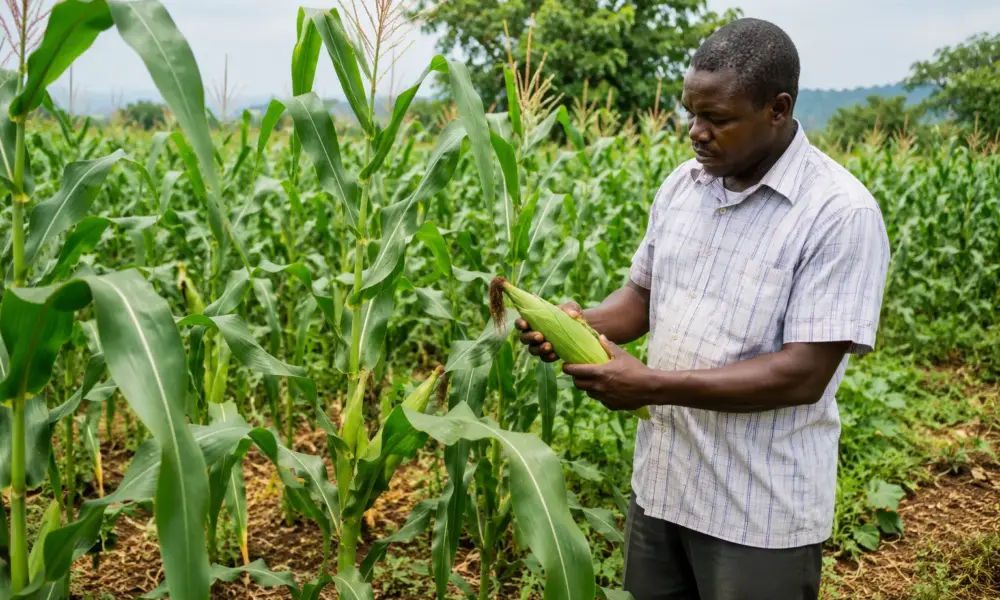
Maize is one of Uganda’s most important food and cash crops. Over 90% of the country’s maize is produced by smallholder farmers, and about 60% of the annual output is consumed on the farm, either roasted, steamed, or processed into posho. Despite its ubiquity, however, maize farming in Uganda continues to offer untapped potential, particularly in the areas of value addition and post-harvest management.
Table Of Content
According to the Ministry of Agriculture, Animal Industry and Fisheries (MAAIF), maize supports the livelihoods of millions of smallholder farmers nationwide and is produced across both intensive and extensive farming systems. So, what does it take to make maize farming genuinely profitable in Uganda? This guide breaks it all down.
Where Maize Grows Best in Uganda
Maize is grown in most parts of Uganda but is cultivated most intensively in the eastern region, specifically in Kapchorwa, Mbale, Kamuli, Jinja, and Iganga. It is also widely grown in central Uganda, including Masaka and Mubende, and in the western region in areas such as Masindi, Kamwenge, Kyenjojo, Kasese, and Kabarole. In North Bukedi, moreover, maize is among the most widely grown commodities, produced both intensively and extensively.
Because maize requires a fairly rough seedbed that encourages water filtration and resists soil erosion, good seedbed preparation is critical. A fine seedbed is preferable for machine planting, while a rougher seedbed remains acceptable for manual planting, as each seed can be placed at the correct depth even without mechanical interference from large clods.
Choosing the Right Maize Variety
Selecting the right maize variety is one of the most consequential decisions a farmer makes before a planting season. In Uganda, the most widely grown varieties fall into two broad categories: open-pollinated varieties (OPVs) and hybrid varieties. Common OPV varieties include Longe 4, Longe 5 (Nalongo), Victoria 2, We2106, and Yara 41 and 42. The older Longe series varieties, including Longe 10H, Wanak, Kayongo-Go, and the VP-max and Bazooka varieties, remain popular as well. For hybrid maize, commonly grown varieties include SC301, SC403, SC513, Hybrid 6H, and 2H, as well as the DK and DH series. For updated variety recommendations, MAAIF’s Agricultural Extension Services provides farmer-facing guidance countrywide.
Planting and Field Management Practices
When investing in an acre of maize, a commercial farmer typically spends UGX 100,000 to 120,000 on land ploughing, UGX 150,000 on hybrid seeds, UGX 150,000 on fertilisers, and another UGX 150,000 for general farm maintenance. On the other hand, a subsistence farmer spending UGX 70,000 on seeds and UGX 150,000 on fertilisers can still achieve a yield of approximately 1,000kg per acre.
For optimal yields, plant at a spacing of 75cm by 60cm and apply farm-yard manure or NPK fertiliser at a rate of 50kg per acre. After three weeks, top dress with UREA or CAN at 50kg per acre, as UREA contains nitrogen that significantly increases crop health and, consequently, yields. The detailed cost-benefit structure for maize production is available in the MAAIF Agriculture Value Chain Development Programme framework.
Controlling the Deadly Stalk Borer
The stalk borer is the single biggest threat to maize plants in Uganda. It operates by laying eggs on maize plant leaves, with the larvae eventually feeding on the plant during the larvae stage, which is also the most dangerous phase. However, scientific research has shown that planting Napier grass alongside maize is one of the most effective natural controls. Since the Napier plant has a sticky substance inside that traps the borer, very few larvae survive. Therefore, farmers are advised to plant at least three rows of Napier alongside their maize, and to plant the Napier slightly earlier so it is more mature when the maize crop is at risk.
Additionally, it is important to leave the maize shamba bare for at least three months after harvesting, as this destroys all remaining pests. Furthermore, off-season maize production introduces a risk of pollen grain contamination in surrounding gardens, so farmers should avoid planting maize outside the main season.
Harvesting and Post-Harvest Handling
After 120 days, most maize varieties are ready for harvesting. To get good quality grain, make sure the maize is doing dry grain before harvesting, and hoist it by at least one foot off the farm floor during storage. Use good cereal storage bags to prevent rotting. It is critical to remember that leaving grain in the rain can lead to rotting, which then causes aflatoxins that are deadly if ingested by both humans and livestock. For storage and post-harvest best practices, MAAIF’s extension directorate provides resources to help farmers reduce post-harvest losses.
Maize Value Addition: How to Earn More Per Kilogram
The most impactful way to earn more from maize farming in Uganda is through value addition. You need 100kg of maize grain to produce 70kg of fine maize flour. If you sell each kilogram of grain at UGX 600, you would earn UGX 60,000. However, if you process it into flour and sell each kilogram at UGX 1,500, you would earn around UGX 105,000, and you would also retain at least 20kg of maize bran. A kilogramme of bran costs between UGX 500 and 800, providing yet another income stream. According to MAAIF statistical data, an acre of maize in Uganda produces on average 800kg of fine flour.
Other High-Value Maize Products
Beyond flour, there are several other ways to add value to maize. Dried grains can be roasted and sold as snacks in supermarkets. Children’s popular cereals and snacks such as Gorrilos are also made using maize flour as a base. Furthermore, maize is used to produce whole grain cereals, bread, pancakes, and even beer, while maize stovers can be repurposed as silage for livestock, offering yet another source of farm revenue.
Profitability at a Glance
Based on MAAIF data, a subsistence maize farmer with a yield of 700kg per acre earns a gross income of approximately UGX 490,000. A low-input commercial farmer can achieve yields of 1,000kg per acre and earn UGX 700,000, while a high-input farmer targeting 2,500kg per acre can gross UGX 1,750,000. These figures make it clear that the path to maximum profitability runs through improved inputs, better agronomic practices, and, above all, value addition. To stay updated on market prices and production benchmarks, refer to the latest MAAIF Statistical Abstract.
Disclaimer: Africa Agricultural Network (AAN) is committed to informing and empowering agricultural communities across Africa as per our mandate. This article is intended for informational purposes only. Readers are advised to verify all details directly with the relevant agricultural organizations before making any decisions

No Comment! Be the first one.