
Africa Agri Expo 2026: Smart Farming Leads the Way
Africa is not just farming, Africa is innovating. That was the resounding declaration that opened the 9th Africa Agri Expo 2026 (AAE 2026) on 11 February 2026 at the Kenyatta International Convention...

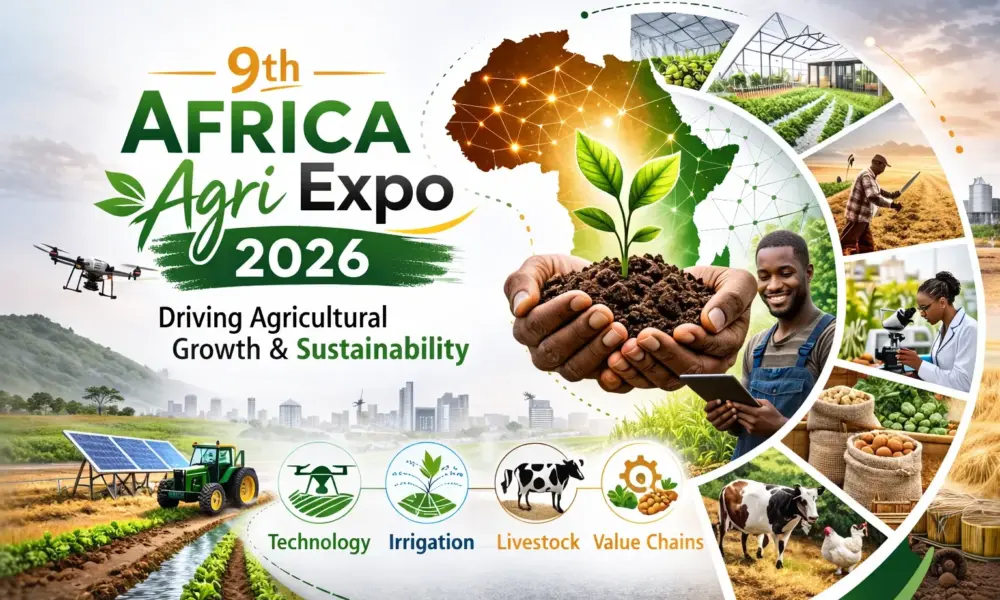
Africa is not just farming, Africa is innovating. That was the resounding declaration that opened the 9th Africa Agri Expo 2026 (AAE 2026) on 11 February 2026 at the Kenyatta International Convention Centre (KICC) in Nairobi, Kenya. Consequently, what followed over two intensive days was far more than a trade exhibition. It was a continental statement of purpose, a gathering of minds, and a marketplace of solutions for one of humanity’s most pressing challenges: feeding a rapidly growing Africa.
Table Of Content
- How precision tools are transforming African farming
- Why Africa must turn its harvests into finished products
- How African farmers are adapting to a changing climate
- Bridging Africa’s infrastructure gap through Policy and Investment
- Youth and Women: The Architects of Africa’s Food Future
- Africa Agri Expo 2026 key takeaways at a glance
- Africa’s agricultural moment is now
Now in its ninth edition, the Africa Agri Expo 2026 drew over 10,000 visitors and more than 300 exhibitors from 35 countries. Co-located with the 2nd Future Food, Livestock and Poultry Expo (FLIP 2026), the event was endorsed by Kenya’s Ministry of Agriculture and Livestock Development, a signal of the high-level political will backing Africa’s agri-food transformation.
From AI-powered crop monitoring and drone-assisted pest control to climate-resilient seed varieties and agro-processing innovations, AAE 2026 offered a comprehensive and inspiring look at the tools, policies, and partnerships that will define Africa’s food systems over the next decade. Moreover, the conversations that took place on its sidelines, between investors, governments, and farmer cooperatives, were equally transformative. Above all, the expo reinforced a single truth: the solutions exist, and now is the time to scale them.
How precision tools are transforming African farming
Without question, the dominant theme at Africa Agri Expo 2026 was the accelerating shift from manual, experience-based farming toward data-driven smart farming in Africa. Across the exhibition halls, live demonstrations showcased AI-driven irrigation systems capable of reducing water consumption by up to 40%, drone fleets deployed for early pest and disease detection, and IoT sensor networks delivering real-time soil and crop health data directly to farmers’ mobile phones.
Furthermore, integrated farm management platforms ,drawing simultaneously on satellite imagery, machinery telemetry, and weather forecasting, are making it possible for smallholder farmers to make the same caliber of decisions as large commercial operators. Additionally, several exhibitors showcased blockchain-based traceability systems that allow African produce to meet the transparency requirements of international export markets. As a result, smart farming in Africa is no longer a futuristic concept, it is a present and rapidly scaling reality.
Nevertheless, the central challenge remains not the technology itself, but its last-mile delivery. Panelists repeatedly stressed the need for affordable financing models, localised technical training, and mobile-first interfaces that work in low-connectivity rural environments. Ultimately, the technology must serve the farmer, not the other way around.
Why Africa must turn its harvests into finished products
One of the most urgent and recurring calls at AAE 2026 was straightforward: Africa must stop exporting raw agricultural commodities and start processing them at home. Currently, vast quantities of African cocoa, coffee, cashews, and grains leave the continent in their rawest form, only to return as finished products at a fraction of the value added elsewhere. Therefore, local value addition is not merely a supply chain efficiency argument, it is a matter of economic sovereignty.
Exhibitors demonstrated a wide range of processing technologies tailored for African conditions, including mobile grain milling units, solar-powered fruit drying systems, and small-scale dairy processing equipment. Meanwhile, Amoko Amoko of the Sabatia Banana Farmers Cooperative Society from Homa Bay County articulated the cooperative’s vision clearly, noting that AAE 2026 was giving them a national and global platform to grow their processing-focused market reach. Similarly, dozens of agropreneurs showcased branded, packaged products that were conceived, produced, and market-ready, all within Africa.
In addition to job creation and income retention, local value addition also strengthens food security by building domestic supply chains that are less vulnerable to global market disruptions. Consequently, policymakers at the expo were urged to prioritise agro-processing zones, reduce import duties on processing equipment, and create tax incentives for value-addition enterprises.
How African farmers are adapting to a changing climate
Climate change is not a distant threat for African agriculture, it is a present, daily reality. Shifting rainfall patterns, prolonged droughts, and erratic growing seasons are already undermining the food security of millions. Accordingly, climate-smart agriculture featured as a non-negotiable pillar of this year’s programme, with innovations ranging from composting techniques for soil health restoration to nanotechnology-enhanced fertilizers that deliver nutrients with unprecedented precision.
Furthermore, water-efficient drip irrigation systems purpose-built for arid and semi-arid African conditions were among the most visited stands on the exhibition floor. Lamberti Agriculture, one of the event’s official sponsors, reinforced this commitment through its exhibition presence, signalling that global agri-input companies increasingly view Africa as a destination for cutting-edge, context-appropriate technology, rather than a dumping ground for outdated solutions.
Notably, several sessions also explored the potential of drought-tolerant and disease-resistant seed varieties developed specifically for African climates, many of them produced by African research institutions in collaboration with international partners. As a result, the message from the climate track was optimistic: Africa has both the knowledge and the tools to farm sustainably, provided these innovations reach farmers at scale.
Bridging Africa’s infrastructure gap through Policy and Investment
No agricultural revolution succeeds in a policy vacuum. Accordingly, a high-level conference session titled “Strengthening Government Support for Africa’s Agri-Food and Livestock Transformation” convened ministers, development partners, and private sector leaders to confront the structural barriers holding back agricultural investment. Chief among the issues raised were the need for expanded irrigated farmland, improved rural road networks, reliable rural electrification, and greater smallholder access to affordable credit.
Kenya’s Principal Secretary of the Ministry of Agriculture acknowledged the expo’s significance, noting its showcase of mechanisation and youth-oriented innovations as proof of the sector’s evolution. In turn, InvestKenya positioned AAE 2026 as a primary touchpoint for attracting foreign direct investment into agrifood systems, underscoring that policy confidence and investor appetite must be cultivated in parallel.
Moreover, panelists stressed that blended finance mechanisms, combining public guarantees with private capital, are the most viable pathway to fund large-scale agri-infrastructure. Without strategic alignment between governments and investors, even the most promising innovations risk dying in the pilot stage, never reaching the millions of farmers who need them most.
“Africa’s food systems challenge is not a lack of ideas, but our ability to turn innovation into widespread adoption. The real work lies in converting knowledge into solutions that reach farmers at scale. Not one of us can do it alone.”
— Aggie Konde, Director of Communications, Innovations & Advocacy, AGRA
Youth and Women: The Architects of Africa’s Food Future
With a median population age of under 25 across much of sub-Saharan Africa, the continent’s demographic profile is simultaneously its greatest agricultural asset and its most urgent challenge. Recognising this, AAE 2026 placed deliberate emphasis on drawing young people and women into agribusiness as founders, innovators, and leaders, not simply as labour.
Agritech startups led by young Africans featured prominently across the exhibition floor, offering everything from AI-powered pest advisory services to digital farm-to-market platforms. Additionally, sessions focused on women’s access to land tenure, credit, and cooperatives, recognising that closing the gender gap in agriculture could increase African food production by up to 20%, according to FAO estimates.
Therefore, the call from AAE 2026 was unambiguous: inclusivity is not a development charity goal. It is an economic strategy. Without the energy, creativity, and perspective of Africa’s youth and women, smart farming in Africa will never reach its full potential, regardless of how sophisticated the technology becomes.
Africa Agri Expo 2026 key takeaways at a glance
- Precision agriculture and AI-driven tools are scaling rapidly from pilot projects to mainstream adoption across African farming.
- Local value addition is a continental economic priority, processing agricultural produce within Africa creates jobs and retains wealth.
- Climate-smart innovations, including nanotechnology fertilizers and drought-tolerant seeds, are being tailored specifically for African growing conditions.
- Policy alignment with private sector investment is essential to finance large-scale agri-infrastructure, including irrigation and rural road networks.
- Youth and women must be central actors, not afterthoughts, in Africa’s agricultural transformation.
- AGRA received an award for its continued support of the AAE platform, recognising its critical role bridging innovation and farmer-level delivery.
Africa’s agricultural moment is now
Ultimately, what the Africa Agri Expo 2026 demonstrated with unmistakable clarity is that the continent’s agricultural transformation is already underway, and it is gaining momentum. The technologies are ready. The farmers are willing. The investors are watching. Furthermore, the political will, while still uneven, is growing. Consequently, the critical variable is no longer whether Africa can lead its own food systems revolution. It is how quickly every actor in the ecosystem, from village cooperative to cabinet minister, can align behind a shared, scalable vision.
As Africa marches toward a projected US$1 trillion agricultural market by 2030, events like the Africa Agri Expo play an irreplaceable role: they bring the future into the present, turning ideas into partnerships, prototypes into products, and ambitions into action. Therefore, the tenth edition cannot come soon enough. Africa’s food future is being built, one innovation, one farm, one farmer at a time.


No Comment! Be the first one.