
Can Science Fix Africa’s $65bn Food Import Bill?
Introduction Africa holds roughly 60% of the world’s remaining uncultivated arable land, yet the continent still can’t feed itself. Sub-Saharan Africa alone spends an estimated USD 65...

Introduction
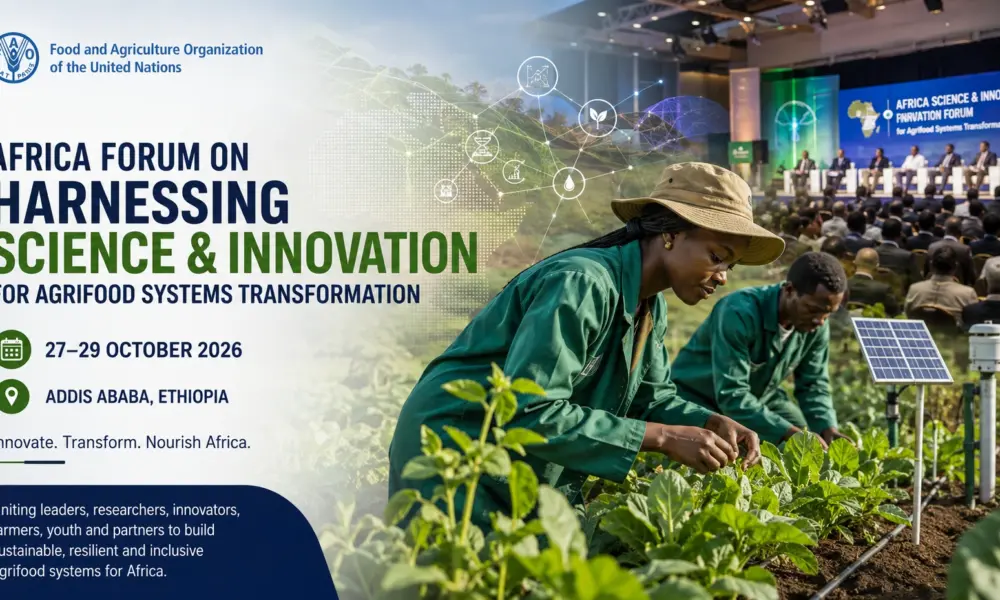
Africa holds roughly 60% of the world’s remaining uncultivated arable land, yet the continent still can’t feed itself. Sub-Saharan Africa alone spends an estimated USD 65 billion a year importing food it could, in theory, grow at home. That contradiction is exactly what a new gathering in Addis Ababa is designed to confront. From 27 to 29 October 2026, the Africa Forum on Harnessing Science and Innovation for Agrifood Systems Transformation, known more simply as the Africa Science & Innovation Forum, organised by FAO will bring policymakers, researchers, investors and farmers into one room to ask a pointed question: if the land is there, what’s actually standing in the way? The answer, organisers argue, has less to do with soil and more to do with how slowly good science reaches the field. Here’s what the Forum is planning to do about it.
Table Of Content
- Introduction
- Why Africa’s Food Import Bill Keeps Climbing
- Inside the Forum: Five Pillars, One Goal
- Productivity and Value-Chain Optimization
- Sustainable Resilience
- Science, Innovation and Policy Interface
- Investment and Partnerships
- Inclusivity
- Who’s Behind the Forum
- What the Forum Hopes to Deliver
- How to Attend
Why Africa’s Food Import Bill Keeps Climbing
The Forum’s organisers are blunt about the scale of the problem. Low agricultural productivity, climate vulnerability, post-harvest losses, food safety gaps and fragmented innovation ecosystems have all combined to hold back agrifood systems across the continent, even as the raw ingredients for self-sufficiency, land, labour and demand, remain firmly in place. Consequently, the gap between Africa’s agricultural potential and its actual output has become one of the clearest examples of underused capacity anywhere in the global food system.
Post-harvest losses alone illustrate just how much is slipping through the cracks. The FAO has long estimated that up to 30% to 50% of Africa’s total agricultural produce is lost between harvest and consumption, a figure that translates to roughly $4 billion worth of grain alone every year, according to a widely cited FAO assessment. Losses run even higher for perishables: fruit and vegetable waste across the continent sits close to 50%, and in Nigeria specifically, tomato losses have been estimated at around 65%, split between poor harvesting and handling, weak transport links, and inadequate storage and processing. The African Union’s Comprehensive Africa Agriculture Development Programme (CAADP) has set a target of halving post-harvest losses by 2025, a goal that gives the Forum’s productivity and value-chain pillar an unusually concrete benchmark to work against.
What’s changed, organisers suggest, is the toolkit available to close that gap. New research breakthroughs, digital platforms, climate-smart farming practices and innovative business models now exist that could meaningfully boost productivity, cut food loss and waste, strengthen resilience, and open real economic opportunities for women and young people. The challenge is no longer whether these tools exist; it’s whether they can be adopted and scaled fast enough to matter.
Inside the Forum: Five Pillars, One Goal
Rather than treating science, policy and investment as separate conversations, the Forum has organised its agenda around five interconnected pillars, each addressing a different link in the chain between innovation and impact.
Productivity and Value-Chain Optimization
Sessions here will dig into technologies and business models capable of lifting productivity and quality across crop, livestock, fisheries and aquaculture systems, while also tackling the losses and waste that quietly erode gains made elsewhere in the chain.
Sustainable Resilience
A second track will showcase solutions that help agrifood systems withstand climate shocks and manage natural resources sustainably, recognising that resilience isn’t a nice-to-have anymore; it’s a precondition for any productivity gains to actually stick.
Science, Innovation and Policy Interface
Because good research rarely translates into good policy on its own, this pillar will examine how scientific evidence can more effectively inform governance frameworks and decision-making at national and regional levels.
Investment and Partnerships
Here, the Forum turns to money: identifying ways to mobilise public and private investment and expand South-South and Triangular Cooperation so that promising innovations can scale well beyond a single pilot project.
Inclusivity
Finally, the Forum will focus on making sure women, youth, smallholder farmers and local communities aren’t just beneficiaries of innovation but active participants in shaping it. The stakes here are significant: agriculture remains the single largest employer of young people across low-income African countries, absorbing well over half of youth employment in many of them, according to African Development Bank data, while FAO estimates put women’s share of the continent’s agricultural workforce at roughly half. Yet both groups remain disproportionately locked out of land ownership, credit, and decision-making roles within the very systems they help sustain, which is precisely the imbalance this pillar is meant to address.
Who’s Behind the Forum
The event is convened by the FAO Regional Office for Africa, working alongside the Forum for Agricultural Research in Africa (FARA), the African Union Commission (AUC), the Regional Universities Forum for Capacity Building in Agriculture (RUFORUM), and other partners. That combination, spanning a UN agency, a pan-African research body, the continent’s political union and its leading agricultural university network, signals an attempt to align research, policy, investment and on-the-ground implementation under a single roadmap rather than four separate ones.
This kind of coordinated push isn’t without precedent. CAADP itself, now over two decades old, was built on the same premise, that African-led agricultural transformation works best when governments, researchers and regional institutions pull in the same direction rather than running parallel, underfunded initiatives. The Africa Science & Innovation Forum effectively extends that logic to a newer set of tools: digital platforms, climate-smart breeding, and innovation financing that didn’t exist, at least not at scale, when CAADP was first launched.
What the Forum Hopes to Deliver
Organisers are framing success in fairly concrete terms. Beyond raising awareness of promising innovations, the Forum aims to strengthen partnerships among governments, research institutions, investors and the private sector, while surfacing real investment opportunities to scale solutions that have already proven themselves. It’s also expected to generate policy recommendations aimed at creating more enabling environments for science and innovation, and to feed into a broader regional roadmap for strengthening Africa’s research and innovation institutions over the long term.
In other words, this isn’t designed as a one-off talking shop. The intended output is a working roadmap, plus the partnerships and investment commitments needed to actually follow it.
How to Attend
The Forum runs from 27 to 29 October 2026 in Addis Ababa, Ethiopia. Those interested in attending can register through the official event page.
Disclaimer
Africa Agricultural Network (AAN) is committed to informing and empowering agricultural communities across Africa as per our mandate. This article is intended for informational purposes only. Event details, themes and dates are drawn from the official Forum announcement available at the time of writing and may be updated by organisers ahead of the event.



No Comment! Be the first one.