

AGRA Receives Borlaug Medallion for Food Systems Work.
Some honours mark a single achievement. Others quietly close a loop that began decades earlier. The Norman E. Borlaug Medallion, now awarded to AGRA by the World Food Prize Foundation, belongs firmly...

Some honours mark a single achievement. Others quietly close a loop that began decades earlier. The Norman E. Borlaug Medallion, now awarded to AGRA by the World Food Prize Foundation, belongs firmly in the second category. On the surface, it looks like recognition for twenty years of institutional work. Underneath, it reads as something closer to a scorecard on an unfinished challenge Dr. Norman Borlaug himself left behind, one that AGRA has spent two decades quietly working to answer through the transformation of Africa’s food systems.
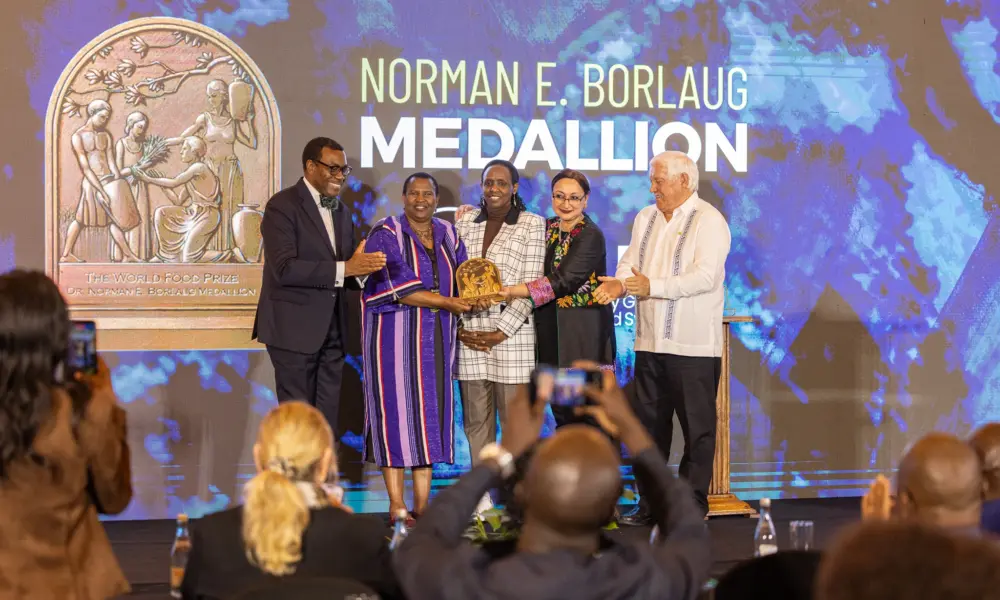
The medallion was presented on 30th June 2026 at the DialogueNEXT Africa event in Nairobi, Kenya, a gathering explicitly built around celebrating food systems transformation across the continent. World Food Prize Foundation President Mashal Husain used the moment to make a broader point: AGRA’s work, in his view, demonstrates that Africa’s agricultural future is being authored by African leadership and African-led solutions, not imported ones.
Notably, the timing carries extra weight. The recognition lands exactly as AGRA marks its own 20th anniversary, turning what might have been a routine milestone into something with far more historical resonance. Husain went further, framing the award as a partial fulfillment of one of Borlaug’s final hopes, an Africa capable of feeding itself, nourishing its people, and contributing to, rather than depending on, global food security.
An Unfinished Challenge, Picked Up in 2006
To understand why this recognition matters, it helps to rewind further than AGRA’s own history. Dr. Norman Borlaug, the agronomist behind Asia’s Green Revolution, is widely credited with helping stave off famine across much of the developing world in the twentieth century. Yet Africa remained largely untouched by that transformation. Before his death, Borlaug left the continent with a directive rather than a blueprint: take it to Africa, take it to the farmer.
That line sat unanswered for years, until AGRA was founded in 2006 with the explicit goal of transforming food systems across the continent, from smallholder farms to national policy. Two decades on, the organization has worked alongside governments, researchers, businesses, and development partners to rebuild how African food systems function, from the ground up rather than from the outside in.
Here’s where the story takes an unexpected turn. Accepting the medallion, AGRA President Alice Ruhweza did something rarely seen at award ceremonies of this scale, she immediately pointed the credit away from AGRA itself. Rather than treating the award as institutional validation, she described it as a shared inheritance belonging to the organization’s founding donors, past leadership, and two decades of partners who built the work long before the ceremony ever took place.
She singled out Dr. Agnes Kalibata, who led AGRA for a decade of its history, crediting her leadership with shaping the institution into what it is today. Yet even that acknowledgment wasn’t the final destination for the credit. Ultimately, Ruhweza dedicated the recognition to the millions of smallholder farmers AGRA works alongside, with particular emphasis on women farmers, whose labour, she noted, quietly sustains families, communities, and food systems across the continent.
What Food Systems Transformation Looks Like Next
For AGRA, the anniversary and the award together function less like a finish line and more like a pivot point. The focus remains on strengthening national food systems, supporting inclusive, market-driven agricultural transformation, and expanding opportunities for farming families across the continent. Meanwhile, Borlaug’s original challenge, take it to the farmer, still functions as the operating principle behind that work, twenty years in and, by every indication, for the next twenty as well.
Ultimately, awards named after towering historical figures often risk becoming ceremonial. This one doesn’t quite fit that mould. It marks a rare instance where a challenge issued in one era found its answer built out in another, not by the man who issued it, but by an institution, and millions of farmers, determined to see Africa’s food systems transformation through to completion.
Disclaimer
Africa Agricultural Network (AAN) is committed to informing and empowering agricultural communities across Africa as per our mandate. This article is intended for informational purposes only. Readers are advised to verify all details directly with AGRA and the World Food Prize Foundation for the most accurate and up-to-date information.
No Comment! Be the first one.