
29-YR-OLD UGANDAN AGRIPRENEUR WINS COMMONWEALTH YOUNG PERSON OF THE YEAR AWARD
Every morning on her family’s tomato farm in Western Uganda, a young Shifra Ainomugisha would rise before dawn, pick up a bucket, and walk into the rows of tomato plants to collect what had...

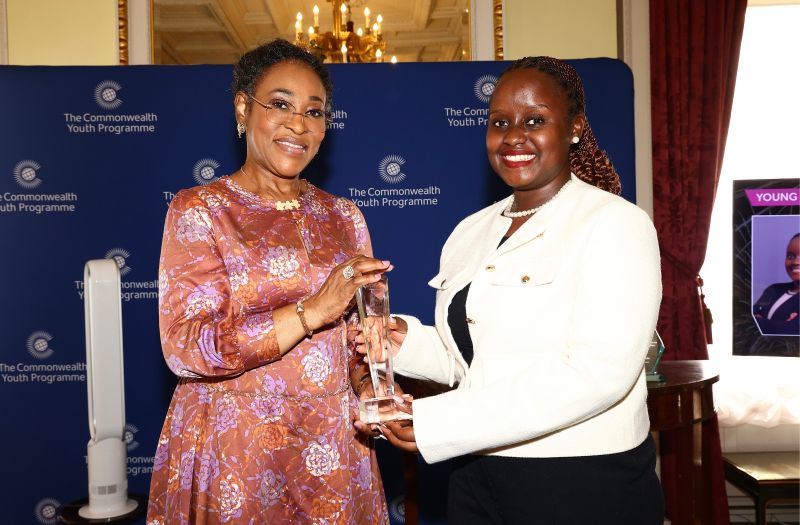
Table Of Content
- Growing Up With Food Loss: The Origin of a Mission
- What Solafam Does: Three Technologies, One Mission
- Solar-Powered Cold Storage
- Solar Irrigation Systems
- Lean AI: Agriculture Advisory for Everyone
- The Numbers That Tell the Story
- A Double Win and a Global Stage
- Why Solafam’s Model Matters for Africa’s Food Future
Every morning on her family’s tomato farm in Western Uganda, a young Shifra Ainomugisha would rise before dawn, pick up a bucket, and walk into the rows of tomato plants to collect what had already been lost. The tomatoes looked healthy from a distance. But up close, many had softened, burst, or spoiled overnight, too far gone to sell and too significant to ignore. “I used to wake up every morning to collect rotten tomatoes and throw them away while trying to save whatever remained,” she recalled. Almost half the family’s harvest disappeared this way.
That childhood reality, of abundance turning quietly into loss and of hard work failing to translate into security, would eventually become the foundation of one of Africa’s most compelling agritech stories. On 25 June 2026, at a ceremony in London, Shifra Ainomugisha, 29, co-founder and Chief Executive Officer of Solafam Uganda Ltd, was named the 2026 Commonwealth Young Person of the Year, selected from nearly 1,000 applicants across the Commonwealth’s 56 member countries. It was a double victory, as she also received the top regional award for Africa, earning a total prize of £5,000, the largest sum given out this year.
Furthermore, she was recognised as Africa’s regional winner under Sustainable Development Goal 2: Zero Hunger, cementing her position not just as a national inspiration but as one of the continent’s most important young voices in the global conversation on food security, climate resilience, and agricultural transformation.
“I am honoured to be named the 2026 Commonwealth Young Person of the Year,” she said accepting the award, overcome with emotion. “This recognition is not only personal but also represents the farmers and communities in Uganda whom we serve. It also affirms that solutions built from lived experience can create real impact.”
Growing Up With Food Loss: The Origin of a Mission
Ainomugisha’s journey began not in a research laboratory but on her family’s tomato farm in Western Uganda, where nearly half of each harvest was routinely lost before reaching the market because of inadequate storage and weak agricultural infrastructure. Despite producing food, the family struggled to generate sufficient income to meet basic needs, including school fees.
Those experiences were not simply formative. They were radicalising. They showed Ainomugisha not just that the problem of post-harvest loss was real and painful, but that it was also deeply unjust. Farmers were working hard, producing food, contributing to Uganda’s agricultural output, and yet the system around them was structured in a way that guaranteed they would lose a significant portion of what they worked to produce before it could ever reach a paying customer. Furthermore, she grew up in a patriarchal environment where hard work was often perceived to be more associated with men than women, an experience that would later shape Solafam’s deliberate focus on women farmers as primary beneficiaries of its technology.
Consequently, when Ainomugisha decided to do something about the post-harvest loss crisis she had witnessed first-hand, she was not approaching the problem as an outside observer seeking a social enterprise opportunity. She was building a solution to a problem she had lived, understood, and felt in the most personal possible terms.
What Solafam Does: Three Technologies, One Mission
Today, Ainomugisha serves as co-founder and Chief Executive Officer of Solafam Uganda Ltd, a social enterprise using solar-powered technologies and artificial intelligence to help smallholder farmers reduce food losses, improve yields and increase incomes. Her work combines three interconnected interventions: solar-powered cold storage, solar irrigation systems and an AI-enabled advisory platform known as Lean AI, a WhatsApp chatbot designed to guide farmers on planting decisions, irrigation timing, pest management, post-harvest handling and market access.
Each of the three technologies addresses a distinct but related constraint in the smallholder farming experience, and together they create something greater than the sum of their parts.
Solar-Powered Cold Storage
The most immediate cause of post-harvest loss for most Ugandan smallholder farmers is simple: the absence of cooling infrastructure. Without access to cold storage, farmers are forced to sell their produce immediately after harvest, often at distress prices, because waiting means watching their crops deteriorate. Solafam’s solar-powered cold storage facilities extend the shelf life of fresh produce significantly, giving farmers the time they need to access better markets, negotiate better prices, and avoid the ruinous cycle of distress selling that has defined smallholder horticulture across Uganda for generations.
Solafam eventually introduced a pay-per-use model. The impact, Ainomugisha says, became measurable. “What makes us proud is that we have increased farmers’ incomes by 28 percent. We have also reduced post-harvest losses by about 30 percent.”
Solar Irrigation Systems
Solar irrigation systems reduce dependence on costly diesel pumps while enabling year-round cultivation. For smallholder farmers whose livelihoods depend entirely on rainfall patterns that are becoming increasingly unpredictable as climate change reshapes Uganda’s agricultural seasons, solar-powered irrigation consequently represents more than a productivity tool. It is a climate resilience intervention that allows farming to continue through dry spells that would otherwise force a complete halt to production.
Furthermore, by replacing diesel-powered pumps with solar alternatives, Solafam is simultaneously reducing the carbon footprint of smallholder irrigation and reducing the operating costs that eat into already thin farmer margins.
Lean AI: Agriculture Advisory for Everyone
Perhaps the most innovative element of Solafam’s integrated model is Lean AI, a WhatsApp-based artificial intelligence platform that delivers real-time, location-specific agricultural guidance directly to farmers’ mobile phones. Lean AI gives farmers real-time advice on planting, irrigation scheduling, pest management, post-harvest handling and market access.
The platform addresses a structural challenge that has constrained agricultural productivity across Africa for decades: the persistent shortage of agricultural extension officers capable of reaching remote farming communities with timely, contextually relevant advice. Many governments across the continent maintain extension services that are chronically underfunded and understaffed, leaving millions of smallholder farmers to make critical production decisions without access to the expert guidance they need.
Furthermore, in recognition of the digital divide that leaves many rural farmers without smartphones, Solafam is now adapting its advisory platform to function through USSD technology, allowing farmers without smartphones to access agronomic information using basic mobile devices. This adaptation is consequently one of the most important features of Lean AI from an inclusivity perspective, ensuring that the most resource-constrained farmers are not left behind as agricultural digitalisation advances.
The Numbers That Tell the Story
Since launching operations in 2022, Solafam’s impact on the ground has been both measurable and compelling. Since 2022, Solafam has reached more than 1,500 smallholder farmers, 70% of whom are women, cutting post-harvest losses by 30% and increasing household incomes by 28%, thereby building economic and climate resilience for women and youth in Uganda.
These figures are significant individually. Together, they are transformative. A 30% reduction in post-harvest losses means that farmers are capturing meaningful additional revenue from the same amount of productive effort. A 28% increase in household incomes means school fees paid, health costs covered, and the kind of economic breathing room that allows families to plan beyond the next harvest cycle. Furthermore, the fact that 70% of Solafam’s beneficiaries are women reflects a deliberate and evidence-based choice that improving women’s access to productive agricultural technologies generates outsized returns not just for individual households but for entire communities.
A Double Win and a Global Stage
The Commonwealth Youth Awards support young changemakers aged 15 to 29 by scaling up their innovation. Since their inception, these awards have invested over £400,000 directly into grassroots youth-led enterprises. The investments have reached more than 12 million beneficiaries, generated over 4,250 jobs, and contributed to all 17 SDGs.
Ainomugisha was selected from a shortlist of 20 regional finalists drawn from across the Commonwealth, including applicants from Cameroon, Kenya, Sierra Leone, Bangladesh, Pakistan, India, Canada, the United Kingdom, Jamaica, and Australia. The breadth of that shortlist consequently makes her double win, as both Africa Regional Winner and overall Commonwealth Young Person of the Year, all the more significant as a statement about the quality and relevance of the innovation she has built.
Commonwealth Secretary-General Hon. Shirley Ayorkor Botchwey presented the award personally, telling the ceremony’s gathered government representatives, high commissioners, and youth leaders: “My congratulations to you all finalists. You are already winners. To be selected from across 56 nations is a testament to your courage and your creativity. You embody the very best of our family. You have shown resilience in the face of challenge and innovation in the face of constraint. Today is not about recognition alone, it is about momentum. It is not about isolated excellence, it is about collective advancement.”
The ceremony also celebrated Kenya’s Maria Angela Maina, founder of Social Justice Insights Kenya, who won the inaugural Patsy Robertson Award for Outstanding Communications Skills for her digital platform using research, advocacy, and storytelling to educate young people on gender-based violence, femicide, and women’s rights, further underscoring the depth of women-led social innovation emerging from across the African continent.
Why Solafam’s Model Matters for Africa’s Food Future
Agriculture contributes between 20% and 30% of gross domestic product in many African economies while employing most rural populations. Reducing food losses could strengthen national food security, improve export competitiveness and reduce pressure to expand farming into environmentally sensitive ecosystems.
Furthermore, as governments, development finance institutions and private investors expand support for agricultural transformation across Africa, innovations such as those pioneered by Ainomugisha demonstrate how locally developed technologies can address structural development challenges while advancing climate resilience, rural industrialisation and inclusive economic growth.
The significance of the Solafam model extends consequently well beyond the immediate impact on the 1,500 farmers currently served. It demonstrates that the most powerful agricultural innovations for Africa are frequently not imported from elsewhere but built from within, by young people whose understanding of the problem is rooted in lived experience rather than external observation. Furthermore, it shows that solar energy, artificial intelligence, and mobile technology, when integrated thoughtfully around the real daily realities of smallholder farmers, can deliver measurable, scalable, and sustainable impact even in resource-constrained rural environments.
Ainomugisha’s story is therefore not simply an inspiring individual achievement. It is a proof point for an entire model of agricultural innovation, and a call to action for the investors, governments, and development partners who have the resources to help scale it.
Disclaimer
Africa Agricultural Network (AAN) is committed to informing and empowering agricultural communities across Africa as per our mandate. This article is intended for informational purposes only. Readers are advised to verify all details directly with Solafam Uganda and the Commonwealth Youth Programme before making any decisions.

No Comment! Be the first one.