
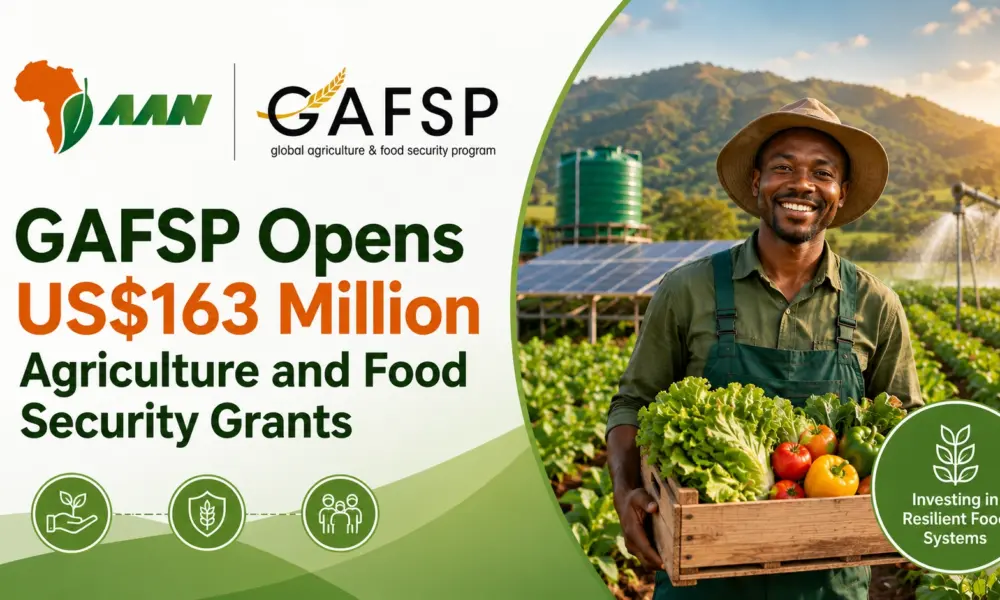
GAFSP Opens US$163 Million Agriculture and Food Security Grants 🌍🌾
The world is facing a food security crisis of historic proportions. 266 million people across 47 countries experienced high levels of acute food insecurity in 2025, the second-highest severity on...

The world is facing a food security crisis of historic proportions. 266 million people across 47 countries experienced high levels of acute food insecurity in 2025, the second-highest severity on record and nearly double the proportion affected a decade ago. Conflict remains the primary driver, compounded by climate shocks, recent rises in fertilizer prices due to the closure of the Strait of Hormuz, and economic volatility. At the same time, overseas development assistance fell 23 percent in 2025, the steepest single-year decline on record.
Table Of Content
It is precisely into this environment that the Global Agriculture and Food Security Program (GAFSP) has launched one of the most significant multilateral agricultural funding initiatives of 2026. A new US$163 million call for proposals has been launched by GAFSP, a World Bank-hosted multilateral fund, inviting governments in the world’s poorest countries to apply for grants to strengthen food security, build climate resilience, and improve livelihoods for smallholder farmers.
Furthermore, this is not simply another development grant. It is a country-led, long-term investment programme backed by the institutional weight of the World Bank Group and designed to reach precisely the places and populations that other funders cannot or will not serve. As Dr. Shobha Shetty, Head of GAFSP, stated: “Smallholder farmers feed their families and their nations, yet they are among the last to receive investment. They bear the sharpest consequences of conflict, climate shocks, and economic volatility. As development budgets tighten across the board, GAFSP offers something increasingly rare through flexible, country-owned grant funding that reaches the places that need it most and invests for the long term.”
The application deadline is 15 September 2026, with funding awards expected in January 2027. For eligible governments, organisations, and stakeholders, the time to engage is consequently now.
What Is GAFSP and Why Does It Matter?
Since 2010, GAFSP has mobilized more than US$2.46 billion in donor contributions, supporting agri-food investments in 53 low-income countries and reaching more than 39 million people. Of that, more than US$1.12 billion in grant financing has been directed to 32 fragile and conflict-affected countries.
GAFSP is consequently not a new or untested programme. It is a proven, globally respected multilateral financing platform with a track record of delivering transformative agricultural investment in the world’s most challenging environments. Its model combines public and private sector financing while connecting governments, agribusinesses, cooperatives, and local farming communities within one broader agricultural development framework.
The 9th Call for Proposals builds on this foundation, introducing a stronger focus on integrated, innovative solutions that simultaneously address climate resilience, nutrition, and women’s economic empowerment rather than funding isolated agricultural interventions in isolation from one another.
What the 9th Call Will Fund
Aligned with the GAFSP Strategic Plan 2025 to 2030, the 9th Call places a strong emphasis on innovative and integrated solutions that improve agricultural productivity, strengthen market access, enhance climate resilience, empower women and girls, and support more sustainable and inclusive food systems. The Call also encourages stronger collaboration across public and private actors, greater alignment with national priorities and global food security initiatives, and increased support for fragile and conflict-affected countries.
Priority thematic areas include climate-smart agriculture and sustainable food systems, agricultural value chain development, irrigation and water management, food and nutrition security, women’s economic empowerment and gender-inclusive agricultural development, and rural livelihoods and community resilience in fragile and conflict-affected environments.
The 9th Call is expected to finance between 6 and 10 projects across eligible low-income countries. Furthermore, the programme introduces a meaningful co-financing incentive: proposals can earn up to 3 additional points for co-financing sourced outside of official development assistance, such as from the private sector or government, and up to 4 additional points if the total co-financing amount equals or exceeds 50% of the GAFSP grant request.
This scoring structure consequently rewards proposals that are able to leverage the GAFSP grant to mobilise additional resources, reflecting the programme’s commitment to maximising the impact and sustainability of every dollar invested.
What Success Looks Like: The Liberia Example
For organisations and governments seeking to understand what GAFSP funding can achieve in practice, the programme’s track record in Liberia offers a compelling illustration. In post-conflict Liberia, GAFSP’s US$46.5 million Smallholder Agricultural Productivity Enhancement and Commercialisation project benefited approximately 155,000 people. Improved seeds, modern machinery, and better agricultural practices boosted staple crop yields, while investment in rural roads and cooperatives helped reintegrate former combatants and displaced communities into productive economic life.
This example demonstrates what long-term, country-owned agricultural investment can achieve even in some of the world’s most fragile and conflict-affected environments. Consequently, it illustrates precisely why the 9th Call’s emphasis on fragile states is not a limitation but a deliberate and important feature of the programme design.
Who Can Participate and How
It is critically important for organisations, NGOs, farmer groups, and agribusinesses to understand how the GAFSP country-led model works, because the pathway to accessing this funding runs through national governments rather than directly through civil society or the private sector.
The Country-Led modality is open to national governments of eligible countries, working in partnership with one of GAFSP’s approved Supervising Entities. Proposals must be submitted by representatives of the eligible national government. NGOs, civil society organisations, individual farmers, consortiums of private sector actors or research institutes, local governments, academic institutions, and individual organisations are not eligible to apply directly. However, applicant countries are expected to demonstrate engagement with civil society, the private sector, farmer organisations, and other relevant stakeholders in the preparation of their proposal.
Countries must be supported by an eligible GAFSP Supervising Entity. Applicant governments may choose one of the following investment Supervising Entities: the African Development Bank, the Asian Development Bank, the International Fund for Agricultural Development, the Inter-American Development Bank, or the World Bank. In addition, countries may optionally choose the Food and Agriculture Organization of the United Nations or the World Food Programme to serve as an additional Supervising Entity for technical assistance activities.
This structure means that for farmer organisations, agribusinesses, NGOs, research institutions, cooperatives, women’s and youth organisations, and private sector actors, the most effective strategy is to engage proactively with your national government and relevant development partners to ensure your sector’s priorities are reflected in the country’s proposal. Consequently, the window to begin those conversations is open right now, well before the September deadline.
Why Organisations Should Act Now
The four-month submission window between May and September 2026 may appear generous, but strong GAFSP proposals require extensive stakeholder consultation, government engagement, Supervising Entity partnership building, and co-financing mobilisation. Furthermore, given that between just 6 and 10 projects will be selected from what is historically a highly competitive pool of applicants, the quality of proposal preparation is consequently a decisive factor in selection outcomes.
For organisations operating in eligible low-income countries across Sub-Saharan Africa, South Asia, and beyond, the most important action item is therefore clear: engage your government and development partners today, share your sector’s priorities and evidence base, and help ensure that the proposals submitted on your country’s behalf are as strong, integrated, and impact-driven as possible.
The call also complements AgriConnect, a World Bank initiative that connects smallholder farmers to digital markets, financial services, and agricultural inputs. By directing grants to IDA-only countries and prioritizing fragile contexts where digital and financial infrastructure is often weakest, GAFSP helps ensure the benefits of initiatives like AgriConnect reach the farmers and communities hardest to serve.
Disclaimer
Africa Agricultural Network (AAN) is committed to informing and empowering agricultural communities across Africa as per our mandate. This article is intended for informational purposes only. Readers are advised to verify all grant details, eligibility criteria, and application requirements directly with the Global Agriculture and Food Security Program before making any decisions.


No Comment! Be the first one.