



This Ugandan Beef Farm Is Mastering Elite Breeds, Artificial Insemination and Better Herd Management.
AL Livestock Farm in Mubende, Uganda is raising Boran, Brahman and Limousin cattle using AI breeding and disciplined herd management. Here is how they do it.

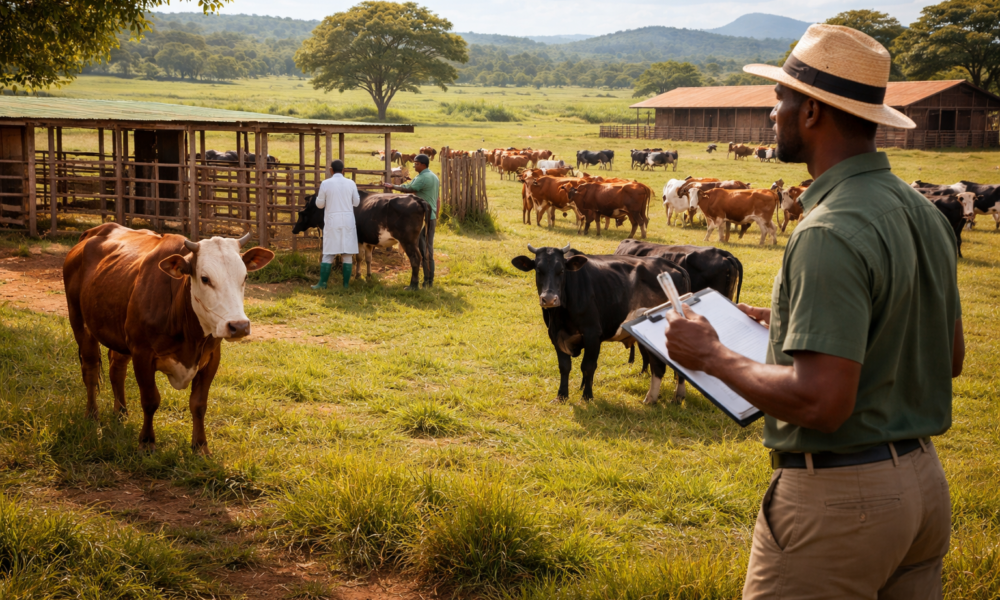
At 6:00 every morning, before the rest of the world stirs, the team at AL Livestock Farm, a beef farm in Katambogo Village, Mubende District, Uganda is already counting animals. Each cow, each calf, each bull, is accounted for by name and number before the herd moves out to graze. It is a discipline that defines how this farm operates: methodical, science-driven, and deeply attentive to the genetics, health, and daily welfare of every animal in the herd.
Table Of Content
The beef farm raises three of the most commercially respected beef cattle breeds in East Africa, the Boran, the Brahman, and the Limousin, and has built its production system around artificial insemination, rigorous record-keeping, and a farm management philosophy that leaves nothing to chance. Consequently, what AAN found at Katambogo is not just a cattle farm. It is a working model for what disciplined beef farming in Uganda can look like at its most intentional.
Furthermore, the farm’s challenges, tick-borne disease pressure, encroaching neighbours, and the constant threat of wildlife snares, are challenges shared by cattle farmers across Uganda and the wider East African region. Therefore, the lessons from Katambogo are lessons every beef farmer on the continent can learn from.
Why Boran, Brahman, and Limousin breeds?
The breed selection at the farm is not accidental. Each of the three cattle breeds was chosen for specific, complementary traits that suit the realities of beef farming in Uganda’s challenging pastoral environment.
The Boran is widely regarded as one of East Africa’s most capable beef breeds. According to The Cattle Site, the Boran developed on the Borana plateau of southern Ethiopia over more than a thousand years, producing an animal uniquely adapted to the harsh conditions of the East African rangelands. It is heat tolerant, tick-resistant, and an efficient converter of low-quality pasture into high-quality beef. Moreover, research published in PMC confirms that the improved Boran can achieve daily weight gains of up to 696g per day under feeding conditions, a remarkable performance figure for a tropical-adapted breed. Additionally, Boran cows are known for strong maternal instincts, high fertility, and the ability to continue calving productively into their fifteenth year.
The Brahman brings complementary strengths. According to ProAgri Media, the Brahman is a medium-to-large beef breed; bulls typically weigh 700 to 1,000kg, with short, glossy hair, pigmented skin, and more sweat glands than most European breeds. These traits allow it to regulate body temperature in hot, humid climates exceptionally well. Furthermore, calves are born small (25–35kg at birth) but grow rapidly, gaining muscle quickly in the weeks after birth, exactly the fast early growth the Katambogo farm team described observing in their herd.
The Limousin, a European breed originating in France, is valued globally for its exceptional muscle mass and lean beef yield. In the AL farm context, the Limousin brings elite carcass quality to a herd already built on the hardiness of East African and tropical breeds.
Artificial Insemination and synchronisation
One of the most technically sophisticated aspects of the AL farm operation is its approach to breeding. Rather than relying solely on natural service, allowing bulls to run with the herd, the farm uses artificial insemination (AI) to control genetics with precision. Consequently, the farm can select semen from bulls with proven performance records, known health histories, and documented calf quality, decisions that would be far harder to manage with natural mating alone.
The artificial insemination process at AL farm begins with synchronization, a hormonal protocol that induces cows to come into heat at a controlled, predictable time. The farm uses a combination of a P-delta device and a hormone called GnRH to synchronise the herd, with animals typically coming into heat within two days of treatment. However, a critical step precedes synchronisation: every cow must first undergo pregnancy diagnosis (PD) to confirm she is not already pregnant. As the farm team explains, administering synchronisation hormones to a pregnant cow will cause it to abort, a costly and preventable loss. Therefore, PD is non-negotiable before any synchronisation protocol begins.
The semen selection process itself is equally deliberate. Before choosing a bull’s semen for use, the team considers the animal’s genetic traits, health history, the growth rate of its previous calves, and its adaptability to local conditions.
“We consider the genetics, the traits, the history of the bull, the health, and how its calves grow. Is that breed resistant to our harsh conditions? You must know before you inseminate.”
— AL Livestock Farm Management Team, Uganda
Daily Management: Counting, Monitoring, and Record-Keeping
The daily rhythm at AL Livestock farm is built around close, consistent supervision. Every morning at 6:00am, the herd is counted as animals leave the kraal to graze. Every evening, they are counted again on their return. This twice-daily headcount, recorded in physical books, ensures that any animal that has remained in the bush, strayed, or failed to return is identified immediately. Consequently, problems are caught early, before a missing animal becomes a lost animal.
Beyond headcounts, the farm maintains detailed livestock records covering calving, breeding, and treatment. Calving records document the mother, the sire, and the calf, creating a traceable genetic history for every animal born on the farm. Within two weeks of birth, each calf is assigned a number and a brand. Treatment records are kept in the field: when a sick animal is identified, the disease is diagnosed, the drugs administered are documented by name and dosage, and the animal’s recovery is tracked through to the completion of the full treatment course. Furthermore, the farm uses daily livestock sensors to support its manual counting system, cross-referencing the morning and evening headcounts to verify herd numbers with an additional layer of accuracy.
Calves are left to suckle from their mothers for six months, a period the farm calls the “winning” phase. At weaning, calves are moved to a dedicated “weaners’ herd” where they transition to supplementary feeds and soft foods, learn to graze independently, and are monitored closely during the adjustment period. Meanwhile, the cow is allowed to recover body condition and prepare for the next breeding cycle. According to Jaguza Farm’s breed management guide, Boran cows are particularly well-suited to this system because of their exceptional maternal qualities and their ability to maintain body condition through lactation, even under nutritional stress.
Disease Control: ECF, Spraying, and the Sick Bay
East Coast Fever (ECF), transmitted by ticks, is one of the most serious threats to beef cattle farming in Uganda and across East Africa. AL farm takes a zero-tolerance approach to tick management: every animal is sprayed every Friday without exception, using a dip spray race in the cattle yard. The regular spraying schedule is not just about controlling ticks on the farm’s own animals, it is also a response to a persistent external pressure. Neighboring farms, whose cattle do not spray or vaccinate, regularly allow their animals to graze on the farm’s pastures at night. Those animals carry ticks that reintroduce the disease risk after each spraying cycle.
When ECF is suspected, the farm’s response is swift and protocol-driven. A thermometer is used immediately to check the animal’s temperature, high temperature being the primary indicator of ECF infection. Treatment follows a structured drug combination: Butalex (buparvaquone) as the primary ECF drug, with Dexamethasone added if the fever is severe, and OTC (oxytetracycline) as an accompanying antibiotic to manage secondary infections. The drug, dosage, and treatment course are all recorded. Furthermore, any animal too weak to walk with the herd to pasture is immediately isolated in the farm’s sick bay, a dedicated recovery area with water, silage, and salt close at hand, where it remains under individual monitoring until it is well enough to rejoin the herd.
According to Farmer’s Weekly SA’s report on the East African Boran, one of the Boran’s most commercially valuable traits is precisely its resistance to the tick-borne diseases and harsh conditions that typify East Africa’s cattle farming environment. Consequently, the farm’s choice to anchor its herd around Boran genetics is not only a production decision, but it is also a disease management strategy.
External Threats: Encroachment, Poaching, and Fencing
Beyond disease, the farm faces challenges that are characteristic of beef farming in Uganda’s cattle corridor regions. The farm is located in a pastoral area where livestock movement is common, and neighboring farmers, whose animals are not vaccinated or sprayed, frequently allow cattle to graze on the farm’s land at night, bringing ticks and disease with them. Additionally, the farm’s bush areas attract poachers hunting wild antelope and other wildlife.
On one recent occasion, a farm cow was caught in a wire snare set by poachers hunting wild animals. The animal was found in the bush, unable to walk, its leg injured by the trap. The team retrieved the animal, dressed the wound, administered treatment, and placed it in the sick bay to recover. Nevertheless, the incident highlights a risk that many Ugandan ranchers in bush areas share: the intersection of livestock farming and illegal wildlife poaching creates dangerous conditions for cattle that range in areas of natural bush.
The farm’s primary response to encroachment is robust perimeter fencing, enforced with strict penalties for anyone caught grazing unauthorized animals on the land. Furthermore, the team is actively working with local authorities to address the poaching problem, since the snares used for wildlife are illegal under Ugandan law and pose a direct threat to livestock and farm workers alike. Therefore, the farm’s management approach is not limited to what happens inside the kraal; it extends to the active defense of the land itself.
Watch the farm video here:
AAN Insight | Why This Matters for Africa
The AL Livestock Farm proves that elite genetics, artificial insemination, and disciplined daily management are not the preserve of large commercial ranches in southern Africa. They are entirely achievable in Uganda’s cattle corridor, on farms operating under real-world pressures of disease, encroachment, and harsh climate. For beef farmers across East Africa, their model of science-driven breeding, meticulous records, and proactive disease control offers a replicable blueprint. At AAN, amplifying stories like this is central to our mandate.


No Comment! Be the first one.