

She found a way to cook beans in just 10 minutes & not hours.
A young lady entrepreneur is changing how beans are cooked with an innovation that cuts cooking time to just 10 minutes, bringing convenience to everyday meal

Introduction
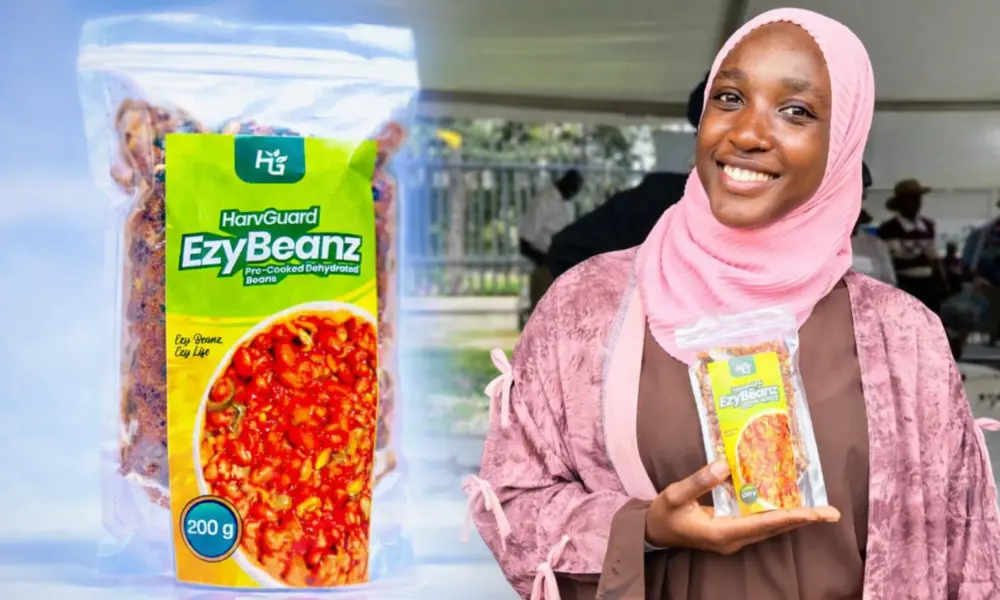
Beans are a daily staple for millions of East African families, yet cooking them remains a time-consuming challenge usually hours. Therefore, when Ramizah Namatovu, a fresh graduate of Busitema University’s Agro-Processing Engineering program, decided to launch HarvGuard Ezy Beanz, she was not simply starting a food business. She was consequently addressing a deeply felt, everyday need.
Table Of Content
In this exclusive Q&A feature, Ramizah walks us through her journey from a broke campus moment that sparked the idea, to navigating Uganda’s limited food-processing infrastructure, and ultimately building a product that now sits on supermarket shelves at just 3,000 Ugandan shillings.
Background & Birth of the Idea
Q: Tell us about yourself and how you got started in this business.
Ramizah : My name is Ramizah Namatovu. I hold a Bachelor of Science in Agro-Processing Engineering from Busitema University, along with a Diploma in Industrial Engineering. I graduated in 2025. Furthermore, I also joined Innovation Spaces, where I initially worked on a cold heat box, a machine that combines cooling and drying simultaneously. However, since building a prototype required significant funding, I turned to pre-cooked beans as a more immediately viable product that could generate revenue while I worked toward that bigger innovation.
Q: What specifically inspired the pre-cooked beans idea?
Ramizah : Interestingly, the idea came during Black November at campus you know, the period when money runs out for students. I was eating beans every single day at the cafeteria. The beans were watered-down and overly salted because the cooks simply couldn’t afford to boil a fresh batch repeatedly. As I sat there eating those tasteless beans, I realized the entire problem was straightforward: beans just take too long to cook. That realization, therefore, was the seed of the whole business.
Q: Did you know others had tried pre-cooked beans in Uganda before?
Ramizah : Honestly, I did not at first. The only pre-cooked bean products I was aware of were from Kenya; they actually have them on supermarket shelves and bean powder from Nigeria. Consequently, when I later discovered that Makerere University had previously attempted something similar here in Uganda, it actually gave me consolation rather than discouragement. It confirmed that a genuine problem exists. Moreover, the fact that Kenya had already proven the market commercially told me this was a viable business not just an experiment.
The Product & Its Value Proposition
Q: Besides convenience, what other problems does HarvGuard Ezy Beans address?
Ramizah : There is actually significant post-harvest waste in Uganda’s agricultural sector, and that deeply concerns me. Farmers lose produce because of poor preservation methods. When the supply chain breaks down due to inadequate post-harvest handling, farmers ultimately bear the greatest losses. However, if we can process beans immediately after harvest cooking and drying them we dramatically extend shelf life. Our properly dried and stored beans can last up to one year without any chemical preservatives. This, therefore, simultaneously reduces farmer losses and gives consumers a fresh, safe product.
Q: People sometimes worry that pre-cooked or processed beans use chemicals. How do you address that concern?
Ramizah :This is actually the biggest misconception I face. People call my beans ‘chemicode’ which is genuinely not the case. I do not add any chemicals. The only ingredient besides the beans themselves is salt for flavor. The extended shelf life comes entirely from the cooking and drying process because removing moisture inhibits microbial growth. In fact, you lose the same volatile nutrients from my beans that you would naturally lose boiling beans at home. The process is therefore no different from what happens in every kitchen; it is simply done in advance for your convenience.
The Production Process: From Farm to Packet
Q: Walk us through how HarvGuard Ezy Beanz are made, from sourcing to the final packet.
Ramizah : The process begins at the farm. As soon as the beans have been harvested and sun-dried by the farmer, we source them, ideally before they sit in storage too long and harden. Fresh, well-dried beans are therefore the foundation of a good final product. From there, we clean and sort the beans carefully, removing any damaged seeds, stones, or debris. Sorting is consequently a critical step because the quality of every single seed going into the batch directly affects the consistency of the final product.
Q: What happens after sorting?
Ramizah : After sorting, the beans are cooked. This is the heart of the entire process, they are boiled until they reach the right level of softness. Importantly, we add salt at this stage for flavor, and that is the only additive throughout. No preservatives, no chemicals, nothing artificial whatsoever. The goal is to cook them to the precise point where they retain their structure and do not become mushy, because they will rehydrate and cook once more in the customer’s kitchen. Getting that balance right consequently took us over one and a half years of product development trials across multiple bean varieties.
Q: How does drying work, and why is it so important to the product?
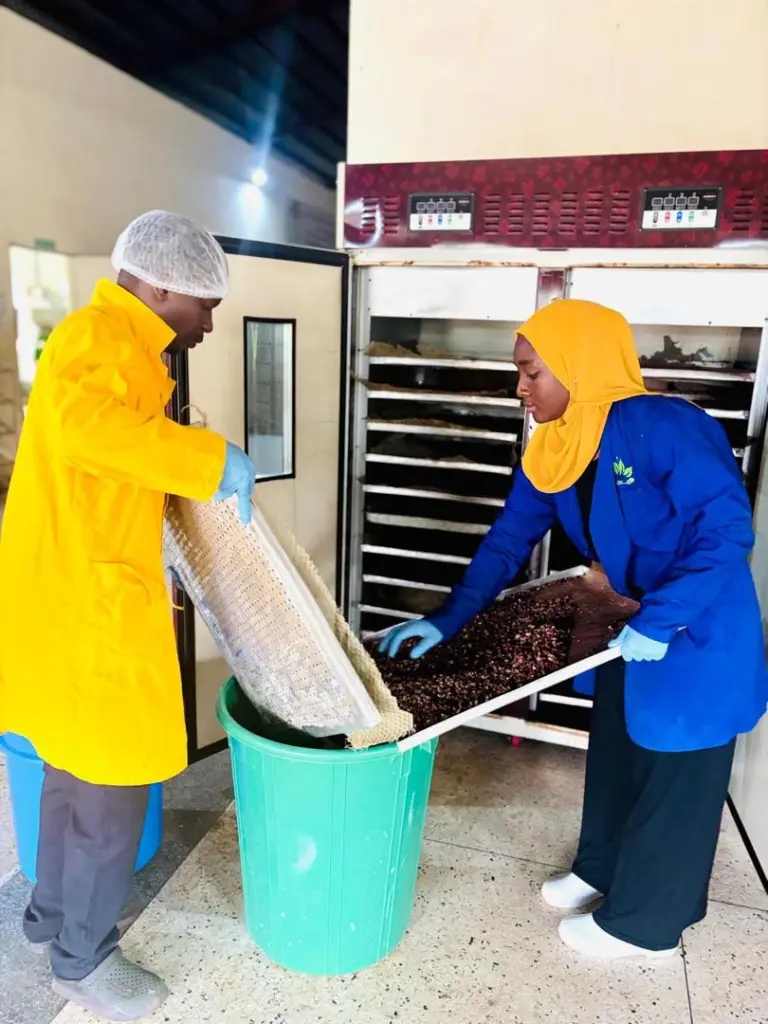
Ramizah : Once cooked, the beans go into the dryer. Drying is ultimately what transforms a cooked bean into a shelf-stable product. By removing moisture to a specific level, we eliminate the environment in which bacteria and mould thrive, which is precisely why, without any chemicals, the beans can last up to one year under proper storage conditions. We currently use the industrial dryers at Kawanda Research Institute for this stage. The drying temperature and duration are carefully controlled so the beans dry evenly and thoroughly, without burning or losing excessive nutritional value in the process.
Q: What does the final packaging stage look like?
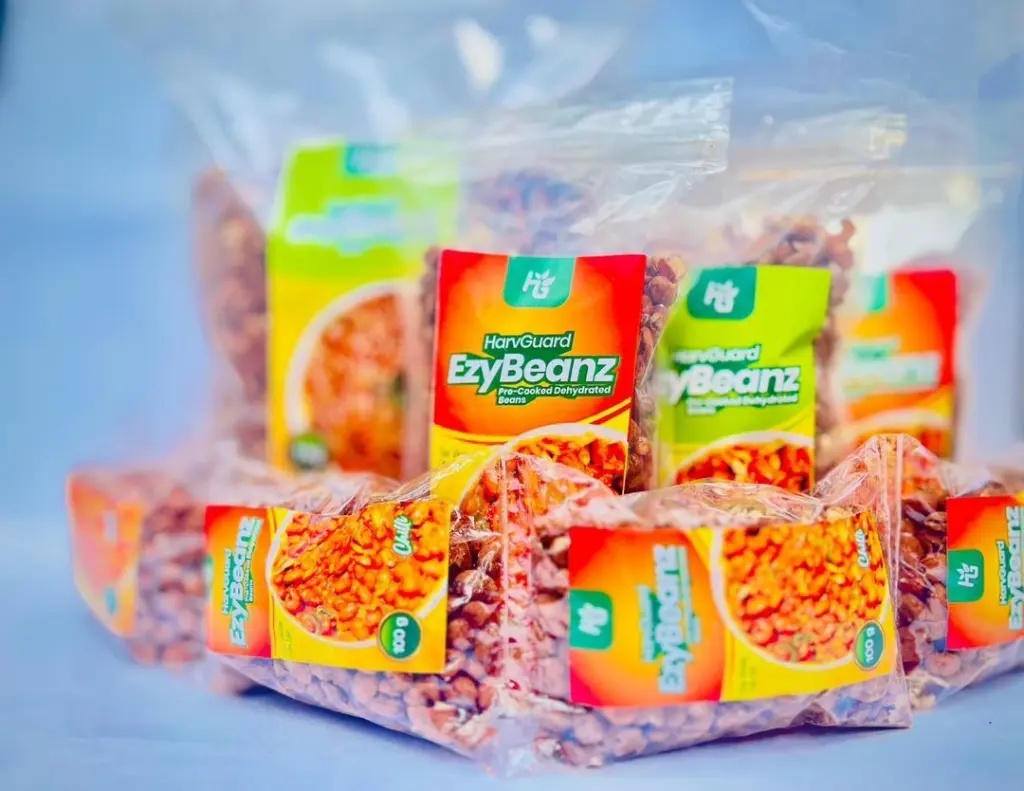
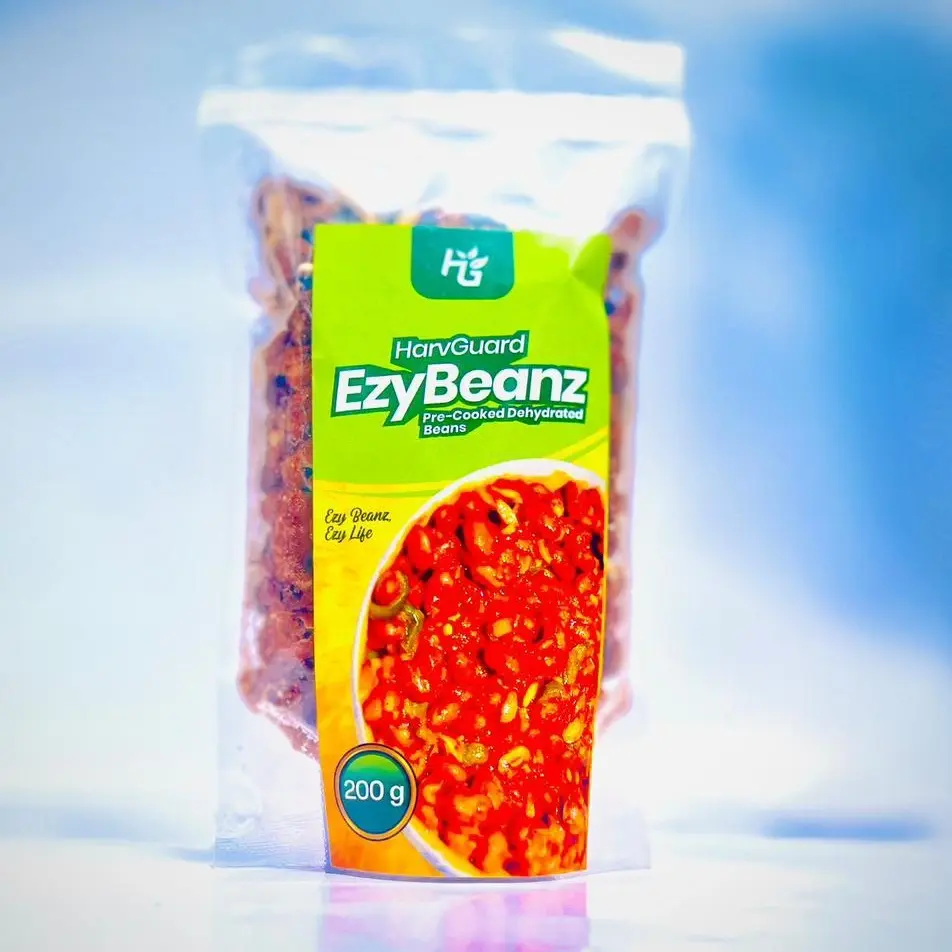
Ramizah : After drying, the beans are cooled, then weighed and sealed into packets. We offer two sizes — 200 grams and one kilogram. Because the beans have lost their moisture content during drying, they are significantly lighter than raw beans, which means each packet contains a greater number of individual bean seeds than an equivalent-weight bag of fresh market beans. Furthermore, once the customer rehydrates them, those seeds plump back up to their original size and weight. The packets therefore deliver considerably more value than they might initially appear to on the shelf.
Q: How do customers cook HarvGuard Ezy Beans?
Ramizah : The process is remarkably simple. First, you soak the beans in hot water, not cold water, because they need gradual rehydration, similarly to how noodles perform better when pre-soaked. While they soak, you fry your onions, tomatoes, and spices. Then you combine the soaked beans with your fried ingredients and let everything simmer together for no more than ten minutes. That’s it. The beans come out soft, flavorful, and aromatic. Additionally, since the beans are dried and therefore lighter, the packet contains more individual seeds than equivalent-weight fresh beans and they expand when rehydrated.
Target Market & Pricing
Q: Who are your primary customers, and did your initial target market differ from who is actually buying?
Ramizah : My initial assumptions were quite different from reality. I first targeted schools, but the product proved too costly for institutional buyers. I also thought campus students would be early adopters, but reaching them effectively requires expensive cooking demonstrations and marketing activations. What actually happened is that my consistent buyers turned out to be busy professionals, single mothers, bachelors, and working women. These are people who leave the office at five, don’t want a two-hour cooking session, but still genuinely love a warm plate of beans. They, therefore, represent the sweet spot between budget and convenience.
Q: How is the product priced and packaged?
Ramizah : We offer our product in three different sizes i.e 100g, 2000g and 1kg. The 200-gram packet retails at UGX. 3,000 and can comfortably feed one person across three meals, or three people in a single sitting. Then we have the one-kilogram family pack, which is ideal for larger households of seven to nine people. Because the beans are dehydrated, the packet contains a proportionally larger number of seeds than fresh beans; they expand significantly upon rehydration. Consequently, customers often find the value exceeds their expectations once they try it for the first time.
Challenges & The Road Ahead
Q: What are the most significant operational challenges you face?
Ramizah : The infrastructure gap is honestly the hardest wall to climb. Currently, only four facilities in the entire country offer commercial food drying: Kawanda Research Institute, Makerere University, Cwen Bombo facility and Churad. Kawanda is a government facility I actively use, but its dryers are oversubscribed and there is no backup generator, meaning a power outage during a drying batch is a total loss. Makerere, meanwhile, has an institutional sensitivity since a university-linked company previously produced pre-cooked beans, making it difficult to operate there. And Churad, though technically available, is prohibitively expensive for a startup at my stage. The bottom line is that I simply cannot scale production to meet large orders under these conditions.
Q: What about profitability, are the margins sustainable?
Ramizah : Quite frankly, the margins are very tight right now. My profit per packet is, at best, below 1,000 shillings and that is on a good day. The dilemma is that lowering the price further would eliminate any margin, yet significantly raising it would price out my core customers who are, above all, attracted by affordability. Therefore, I am essentially balancing on a tightrope, trying not to fall on either side. The real breakthrough will come when I can access affordable, reliable drying infrastructure or eventually own my own equipment.
Q: What is your vision for HarvGuard Ezy Beanz going forward?
Ramizah : My ultimate vision goes beyond just beans. I want to eventually use the revenue from HarvGuard Ezy Beans to fund the development of the cold heat box, the machine that first got me into Innovation Spaces. That technology could genuinely transform post-harvest handling across multiple crops. Furthermore, I also believe that with proper financing, I could fortify the beans replacing the very nutrients lost during processing giving consumers a nutritionally complete, convenient product. The food and health sectors are the only ones that, even during crises like COVID-19, never stop operating. I intend to build within that permanence.
Key Takeaways for Aspiring Innovators
Ramizah Namatovu’s journey with HarvGuard Ezy Beanz offers several compelling lessons for young African entrepreneurs:
First, real innovation starts with a real problem; hers began in a campus cafeteria, not a boardroom. Second, despite facing infrastructure constraints, market education challenges, and razor-thin margins, she has nonetheless built a certified, trademarked product that addresses a genuine daily need. Third, her story demonstrates that the food sector, precisely because of its essentialness, offers resilient entrepreneurial opportunities.
As she aptly puts it: ‘There is no time I’m going to be unemployed in this field.’ That, ultimately, is the spirit driving Africa’s next generation of agro-processing innovators.
AAN Insight; Why This Matters for Africa
HarvGuard Ezy Beanz is proof that African youth and women-led innovation can compete globally. For agribusinesses and rural entrepreneurs across the continent, their model of integrated value chains, farmer income assurance, and sustainable harvesting offers a replicable blueprint worth studying. At AAN, amplifying exactly these kinds of stories is central to our mandate, because visibility is the first step to scale.
Disclaimer
This article is produced for informational purposes only. AAN has no commercial relationship with the subjects featured in this article. All information presented is based on interview responses and has not been independently verified by AAN.


I have tasted the beans and they are awesome. Simply convenient and tasteful… hurray to ezzy beans