


New Insecticide Targets Potato Tuber Moth in South Africa
A tiny moth can undo a whole potato season. The potato tuber moth lays its eggs on leaves and tubers, and its larvae then tunnel through both, in the field and in storage, until a crop that looked...

A tiny moth can undo a whole potato season. The potato tuber moth lays its eggs on leaves and tubers, and its larvae then tunnel through both, in the field and in storage, until a crop that looked healthy becomes unsaleable.
Table Of Content
- SILVALIS at a Glance
- Why Potato Tuber Moth Matters
- How SILVALIS Works Against Potato Tuber Moth
- A new active ingredient
- What happens to the insect
- Staying power on the leaf
- Why a New Mode of Action Helps
- The Potato Sector and Potato Tuber Moth Control
- What Syngenta Says
- Safety Questions Growers Should Ask
- What to Watch Next
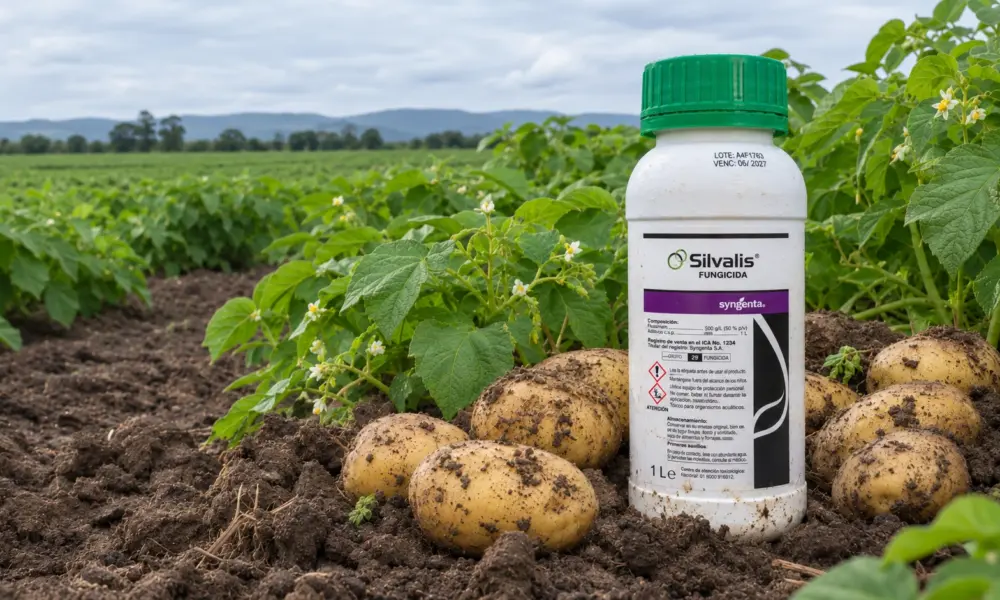
South African growers now have a new product to fight it. On 2 November 2026, Syngenta South Africa announced the launch of SILVALIS®, the country’s first registered IRAC Group 30 insecticide, registered for control of the potato tuber moth (Phthorimaea operculella). It brings a mode of action that has not been used in South African agriculture before.
The timing matters. Potatoes are one of South Africa’s most important staples, and the pest is a known threat. Syngenta says the moth can destroy up to 100% of a commercial crop if left unmanaged, and local research has already found shifts in how moth populations respond to some older insecticides.
This article explains what SILVALIS is, how the technology works and why a new mode of action matters for resistance management. In addition, it sets the launch against the size of the potato sector and the safety questions growers should ask, so you can judge where the product fits in practice.
SILVALIS at a Glance
- Product: SILVALIS®, a suspension concentrate insecticide
- Active ingredient: isocycloseram
- Technology: PLINAZOLIN®
- Classification: IRAC Group 30, a new mode of action in South Africa
- Registered for: potato tuber moth control in potatoes
- Company: Syngenta South Africa
- Development time: about 10 years
Why Potato Tuber Moth Matters
The potato tuber moth attacks leaves, stems and, most critically, tubers. Because damage continues after harvest, a field problem can become a storage problem. It also feeds on other Solanaceae crops such as tomatoes and tobacco, and on weeds like night sage, according to Potatoes South Africa material reported by AgriOrbit.
Potato tuber moth pressure appears to be rising. A study that Potatoes SA commissioned from Prof Hannalene du Plessis and her team at North-West University, reported in 2022, said moth damage had increased in the main production areas. Field visits to Limpopo found moths in abundance.
The same study found that moths from the Sandveld and Limpopo showed shifts in sensitivity to organophosphates, pyrethroids and chitin biosynthesis inhibitors. Indoxacarb still performed as expected at registered rates. Diamides were not assessed. Consequently, growers have good reason to look for fresh chemistry and better rotation.
How SILVALIS Works Against Potato Tuber Moth
A new active ingredient
SILVALIS contains isocycloseram, which belongs to the isoxazoline chemical family. IRAC’s guidelines list it alongside broflanilide and fluxametamide as a Group 30 active ingredient. These compounds act as allosteric modulators of the GABA-gated chloride channel in the insect nervous system.
What happens to the insect
GABA is the main inhibitory signal in insects, so blocking its channel overstimulates the nerves, causing convulsions. Syngenta says SILVALIS disrupts the insect’s nervous system, so feeding stops quickly and further crop damage is limited.
Staying power on the leaf
The company says PLINAZOLIN technology stays active on treated plant surfaces after application at the first signs of infestation. The formulation also holds its activity after rainfall and has enhanced ultraviolet stability, which reduces breakdown in sunlight. Together, these properties are meant to keep performance steady across varying field conditions.
Why a New Mode of Action Helps
Resistance develops when the same chemistry is used repeatedly against the same pest. For potato tuber moth control, a new IRAC group gives growers something different to rotate in, which can slow that process. Syngenta says Group 30 offers a different mode of action from several commonly used insecticide groups.
However, IRAC is clear that Group 30 products need careful use. Its guidelines assume that resistance to one Group 30 insecticide would affect the others, since they share a target site. They also note that long residual activity can create strong selection pressure in a short time.
IRAC’s main advice is straightforward:
- apply at label rates and intervals;
- rotate modes of action within the crop cycle, using treatment windows;
- avoid tank-mixing products from the same group; and
- combine chemistry with integrated pest management (IPM), including scouting, sanitation and conserving natural enemies.
Syngenta Product Biologist Gustav Venter said the launch is part of a broader approach to responsible pest management that combines innovative chemistry, advanced formulation technology and practical field performance.
The Potato Sector and Potato Tuber Moth Control
South Africa is Africa’s third-largest potato producer after Egypt and Algeria, according to Food Business MEA. Per capita consumption was about 37 kg in 2023, above the global average of 33 kg, and potatoes rank fourth among staples after maize, wheat and rice.
The industry is also growing. Farmer’s Weekly reported that planted area reached 53,094 hectares in 2025, with production of 276 million 10 kg bags, about 2.76 million tonnes. That compares with 256 million bags in 2024 and a previous record of 267 million in 2019. Average yield was 52 tonnes per hectare.
Growers also face tighter supply of older crop-protection products, as regulations phase out some older chemistries. As a result, a newly registered option has particular value to a sector with high yields to protect.
What Syngenta Says
Sarike le Roux, Syngenta’s Head of Marketing, said the launch reflects the company’s aim of “turning science and innovation into practical breakthroughs that help farmers achieve higher yields with lower impact.”
Chris Steyn, Syngenta’s Portfolio Manager for Insect Control, said grower feedback has been “always better than anything we predicted,” even better than the company’s own trials suggested. These are the company’s own accounts, so independent trial results will add weight over time.
Safety Questions Growers Should Ask
Safety data on isocycloseram has been published elsewhere. The University of Maryland Extension reported in February 2026 that the US EPA found no human health risks of concern when the active ingredient is used according to registered labels. It also reported that the product is highly toxic to bees and other pollinators, and that negative effects on insect natural enemies are expected.
That information comes from US labels, and South African use will follow the local registration. Growers should therefore read the SILVALIS label carefully, including any restrictions on timing, bees and buffer zones. This is also relevant to the “lower impact” claim, which only the label and independent data can fully test.
What to Watch Next
Several details remain to be seen. For potato tuber moth control, Syngenta has not published the label’s application rates, number of sprays per season or pre-harvest interval in the material reviewed. Moreover, independent trial data under South African conditions would help growers judge performance against current programmes.
Still, the launch gives potato growers a rare new tool. If it is used in rotation within IPM, as IRAC advises, SILVALIS could help protect both potato crops and the future effectiveness of other insecticides.
Disclaimer
Africa Agricultural Network (AAN) is committed to informing and empowering agricultural communities across Africa as per our mandate. This article is intended for informational purposes only. Product claims and figures referenced were drawn from the company’s announcement and published reports available at the time of writing and have not been independently re-verified by this publication. Growers should follow the registered label and consult a qualified crop protection adviser before use.

No Comment! Be the first one.