

Biochar Pays: Ethiopian Farmers Cash In on Soil Carbon
A farmer in Oromia can now earn money for something that happens beneath her feet: locking carbon into the soil. It sounds abstract, but the first payments are real, and they are reaching rural...

A farmer in Oromia can now earn money for something that happens beneath her feet: locking carbon into the soil. It sounds abstract, but the first payments are real, and they are reaching rural households.
Table Of Content
Nearly 300 Ethiopian smallholders have received proceeds from the first sale of soil carbon sink certificates in the country, under the five-year ETH-Soil project. For carbon sinks established by 2025, the average payment is 1,700 Ethiopian birr per farmer, roughly a third of an unskilled worker’s monthly wage.
The project is coordinated by Germany’s DBFZ Biomass Research Centre and funded by Germany’s Federal Ministry for Economic Cooperation and Development (BMZ). It promotes biochar-based fertilisers and integrated soil fertility practices to restore degraded land, lift yields and store carbon.
What Is Biochar, and Why Does It Fit Ethiopia?
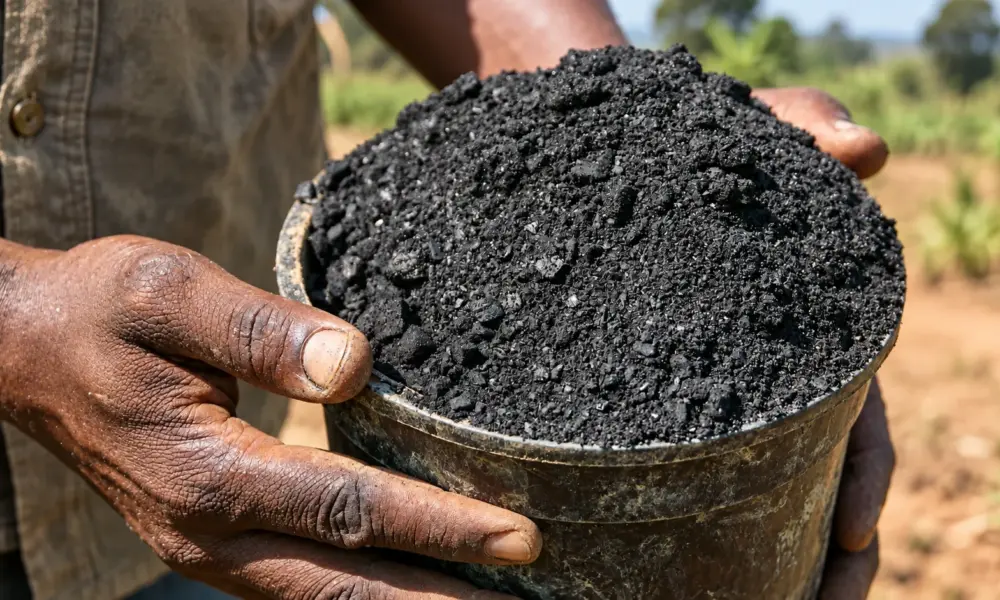
Biochar is a charcoal-like material made by heating biomass with little oxygen. Mixed with compost or other nutrients, it becomes a soil amendment that holds moisture and nutrients and stays in the ground for a long time, which is why it can count as a carbon sink.
Ethiopia has a particular need for such tools. Soil acidity is a major constraint in the highlands, where a large share of arable land is affected and crop yields suffer. The government launched a drive in 2023/24 to treat more than three million hectares with lime over a decade, but lime supply has remained a hurdle.
Biochar offers a local alternative. In the highlands, project reports say it is replacing expensive agricultural lime, helping retain nutrients through heavy rain and improving humus formation.
Inside the ETH-Soil Project
ETH-Soil has operated since 2021, mainly in Oromia, with the aim of improving smallholder livelihoods in food-short rural areas. Training has been a central part of the work, covering biochar production, composting, soil testing and the construction of production and storage facilities.
The project has also expanded into other regions. In Sidama, a train-the-trainer approach that began in May 2025 equipped 20 local development agents to train 100 farmers across 10 kebeles. Meanwhile, collaboration with Jimma University is building local capacity in biogas and fertiliser production from farm residues.
How a Farmer Earns From Carbon
The payments rely on the Global Artisan C-Sink standard from Carbon Standards International. The standard was designed for smallholders in low and lower-middle-income countries who make biochar with simple Kon-Tiki or TLUD methods.
Farmers cannot sell certificates on their own. They join a project run by a C-Sink Manager, who verifies production and registers the carbon sinks. In Oromia, farmers have documented their biochar-making and compost mixing with a mobile app called PlantVillage, which supports the monitoring the standard requires.
Importantly, most of the money goes to farmers. At least 60% of proceeds from the Artisan C-Sink certificates is distributed to smallholders, and the remainder pays for training, data collection, quality control and auditing.
What the Project Reports on Yields and Soil
According to the project’s own findings, biochar-based fertilisers can effectively substitute for synthetic fertilisers while raising productivity. On about 31 hectares of heavily degraded pilot land, staple cereals such as wheat, barley, maize and teff recorded yield increases of 11% to 30% compared with conventional synthetic fertiliser use.
Beans and potatoes did better still, with gains of 9% to 68%. Soil health also improved. In Kofele district, acidic soils with a pH near 5 reached between 5.8 and 5.9 after alkaline biochar was applied, giving crops a friendlier root environment.
The porous structure of biochar explains much of this. It improves phosphate availability, raises soil organic carbon and, like a sponge, holds nutrients that would otherwise wash away in heavy rain.
Cutting Dependence on Imported Fertiliser
Ethiopia has long relied on imported synthetic fertiliser, and global shocks have shown the risk. Disruptions linked to the war in Ukraine and tensions in the Gulf have made supply less predictable.
In response, Oromia has leaned further into alternatives. The project has shown that green manuring and vermicomposting of organic waste can be done throughout the year, easing reliance on imports. Encouraged, the Oromia Regional Government began in 2025 to extend biochar-based fertiliser technologies into other soil fertility programmes supported by Germany, the European Union and the World Bank.
A Balanced View: Opportunities and Limits
The farmer’s economics combine three streams: higher yields, lower spending on synthetic fertiliser and carbon income. That mix is attractive, yet readers should weigh a few cautions.
- The 1,700 birr average is modest, so carbon income works best as a bonus on top of better harvests.
- The yield figures come from the project’s own pilot findings on about 31 hectares, so wider, independent evidence will help.
- Carbon projects depend on careful monitoring, which means trained managers, accurate records and credible auditing.
- Project-level funding ends with the programme, so local ownership will decide whether the model lasts.
Even so, the first payments mark a shift. Farmers are being rewarded not only for growing food, but also for delivering environmental services through sustainable land management. If the model holds, other African countries facing acid soils and costly inputs may soon look to Ethiopia for a template.
Disclaimer:
Africa Agricultural Network (AAN) is committed to informing and empowering agricultural communities across Africa as per our mandate. This article is intended for informational purposes only. Yield figures referenced were drawn from project findings reported by the programme and published media reports available at the time of writing and have not been independently re-verified by this publication

No Comment! Be the first one.