


AATIF Is Now Open for African Agribusiness Financing Applications
For established agribusinesses operating across Africa’s agricultural value chain, one of the continent’s most well-capitalised and patient debt financing vehicles is actively accepting...

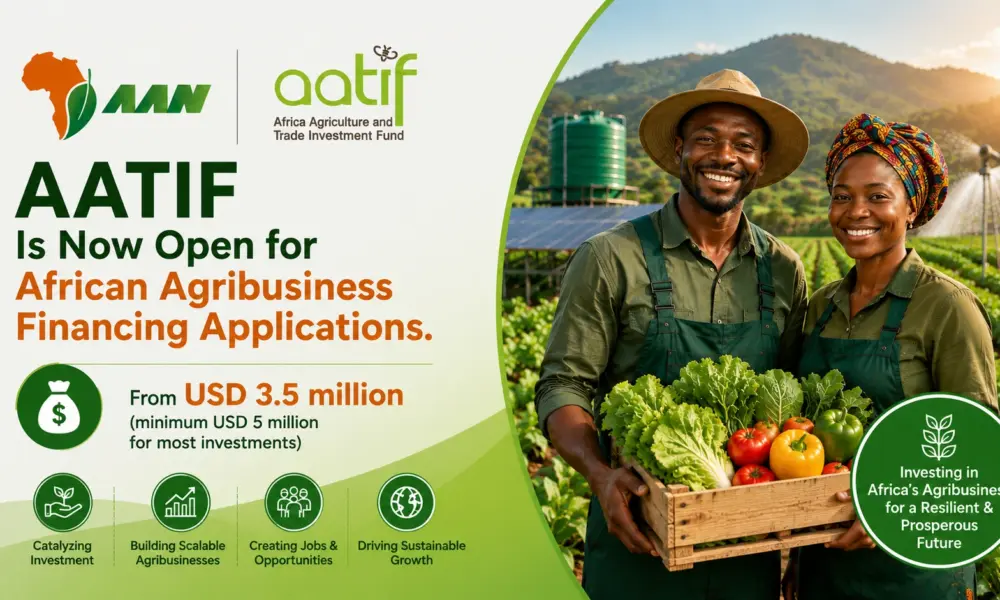
For established agribusinesses operating across Africa’s agricultural value chain, one of the continent’s most well-capitalised and patient debt financing vehicles is actively accepting applications with no fixed deadline and a two-week initial review turnaround.
Table Of Content
The Africa Agriculture and Trade Investment Fund (AATIF) is a blended finance, private debt evergreen fund dedicated to boosting Africa’s agricultural potential by responsibly investing in local agrifood value chains. Backed by the German Federal Ministry for Economic Cooperation and Development (BMZ), the European Commission, and KfW, AATIF has consequently deployed over USD 340 million in capital toward African agribusinesses since its establishment in 2012, making it one of the most experienced and credible agricultural investment funds operating on the continent today.
The Fund targets small, medium and large agricultural businesses along the entire agriculture value chain including input provision, mechanisation, farming, processing, distribution, retail and export. Funding instruments include senior debt, mezzanine, guarantees and risk-sharing arrangements ranging from USD 5 million to USD 30 million with a tenor of up to 12 years.
If your agribusiness is operational, profitable or EBITDA-positive, and ready for patient long-term debt financing to grow, expand, or strengthen its agricultural value chain operations, AATIF consequently represents one of the most substantial and strategically aligned financing opportunities currently available to African agribusinesses.
What Is AATIF ?
The Africa Agriculture and Trade Investment Fund is an innovative public-private partnership dedicated to uplift Africa’s agricultural potential for the benefit of the poor. The Fund aims at improving food security and providing additional employment and income to farmers, entrepreneurs, and labourers alike by investing patiently and responsibly in efficient local value chains.
The word “patiently” in that mission statement is significant and worth dwelling on. Patient capital, meaning long-tenor debt that gives agribusinesses the time they need to build, grow, and generate returns before repayment pressures become acute, remains one of the most structurally scarce forms of financing available to African agricultural businesses. Commercial banks typically offer short-term loans that are poorly suited to the long production cycles, seasonal cash flows, and capital-intensive growth trajectories of agricultural enterprises. AATIF was consequently designed from its inception to fill precisely that gap, providing the kind of multi-year debt financing that agricultural businesses need to grow sustainably and at scale.
Furthermore, the fund’s blended finance structure, using a first-loss layer capitalised by Germany’s BMZ alongside mezzanine and senior layers backed by KfW and the European Commission, means that AATIF is able to take on the risk profiles that purely commercial lenders cannot accommodate, while still maintaining the financial discipline and governance standards that protect all parties involved.
What AATIF Finances
AATIF’s investment mandate is deliberately broad, covering the full spectrum of the agricultural value chain from inputs and production through to processing, distribution, and export. This breadth consequently means that a wide range of agribusiness types and models can be eligible for financing, provided they meet the fund’s core eligibility criteria.
The fund operates through two distinct investment pathways. Direct investments are made into cooperatives, commercial farms, and processing companies that meet AATIF’s financial and development impact criteria. Indirect investments are made through large agribusinesses that function as off-takers, service providers, or credit providers for smallholder farmers and SMEs, effectively channelling AATIF capital through commercially structured intermediary relationships to reach a broader base of smaller agricultural actors.
The Fund provides capital directly to companies and indirectly via intermediary investment companies and financial institutions. End-beneficiaries include entrepreneurs, agribusiness companies, producer cooperatives, small, medium and large-sized farmers, and export-oriented producers in the agricultural, manufacturing and services sectors.
Specific agricultural value chain segments that AATIF has financed across Africa include input provision and mechanisation businesses, commercial and smallholder farming operations, agricultural processing and manufacturing enterprises, distribution, retail, and trading companies, and export-oriented agribusiness ventures. Furthermore, the fund has particular interest in businesses that can demonstrate clear positive impact on smallholder farmers and rural communities through their operations, whether directly or through structured outgrower and supply chain relationships.
The Technical Assistance Facility: More Than Just Money
One of the most distinctive and valuable features of AATIF is its dedicated Technical Assistance Facility, which sits alongside the fund’s debt financing programme and provides something that capital alone cannot deliver.
The TA Facility provides grant funding for projects to strengthen the developmental aspects of individual investments. It provides support to investee companies that focus on enhancing direct impact beyond the company itself, specifically targeting lower-income communities. This type of TA support assists AATIF investee companies to create local economic opportunities and employment, for example through the establishment of a smallholder farmer outgrower scheme. The TA Facility also supports investee companies with advisory and technical support that improves business operations and efficiency, as well as capacity development of staff. AATIF has developed an average of nine TA projects per year with project budgets ranging from EUR 6,000 to EUR 500,000.
For agribusinesses that receive AATIF financing, the Technical Assistance Facility consequently transforms the investment relationship from a purely financial one into a genuine operational partnership, providing grant-funded support to improve environmental and social performance, build management capacity, and strengthen the business systems and governance structures that make a growing agribusiness more sustainable, more investable, and more impactful over the long term.
Who Should Apply?
AATIF’s eligibility criteria are structured around financial readiness and operational maturity, reflecting the fund’s mandate to finance businesses that are genuinely positioned for growth rather than early-stage ventures still finding their feet.
To be considered for AATIF financing, agribusinesses should meet the following core requirements. They must be already operational and past the planning stage, with a demonstrable track record of agricultural production, processing, or trading activity. They must be profitable or EBITDA-positive, or alternatively backed by a strong sponsor whose financial standing supports the investment case. They must have an experienced management team in place with the capacity to manage a significant debt financing relationship and deliver on the fund’s impact requirements. They must maintain an equity to total assets ratio above 30% post-investment, ensuring that the business has a strong enough balance sheet to sustain the additional debt. They must be operating in Africa’s agricultural sector across any country on the continent where AATIF is active, which covers the full breadth of sub-Saharan Africa.
Furthermore, businesses with clear smallholder farmer linkages, environmental sustainability credentials, or climate-smart production practices are particularly well-aligned with AATIF’s development mandate and consequently well-positioned in the fund’s investment review process.
Financing Terms and How to Apply
Funding instruments are senior debt, mezzanine, guarantees and risk-sharing arrangements that range from USD 5 million to USD 30 million with a tenor of up to 12 years. The minimum investment threshold is USD 3.5 million, with most investments starting from USD 5 million, making AATIF most appropriate for agribusinesses at a meaningful commercial scale rather than very early-stage enterprises.
Importantly, there is no fixed application deadline. The investment advisor will contact applicants within 2 weeks after submission and discuss further steps if the project appears eligible following an initial review. This rolling application model consequently means that eligible agribusinesses can apply at any point in their planning cycle without having to wait for an annual call or competitive window.
To apply, agribusinesses submit an online application through the AATIF funding portal, completing a detailed questionnaire and uploading supporting documentation. Required documents include audited financial statements for the past three years where available, and an Environmental and Social Impact Assessment or any other document providing further information on the social and environmental impact of the project.
The application platform furthermore includes guiding notes that highlight minimum requirements as you complete the form, giving applicants real-time feedback on whether their project is likely to meet AATIF’s investment criteria before submission.
Disclaimer
Africa Agricultural Network (AAN) is committed to informing and empowering agricultural communities across Africa as per our mandate. This article is intended for informational purposes only. Readers are advised to verify all financing details, eligibility criteria, and application requirements directly with AATIF before making any decisions.




No Comment! Be the first one.